Boat noise hurts marine mammals in four main ways: it masks the calls and echolocation clicks they rely on, degrades their ability to hunt, raises stress hormones and hearing injury risk, and pushes animals out of feeding grounds. Because sound travels roughly 1500 metres per second in water, a single passing engine can affect animals well beyond visual range. Updated for October 2026.
I have spent enough time around working boats and listening stations to be wary of the lazy version of this story, the one that says whales are used to it. The physics does not support that. Neither does the behavioural record.
This explainer is for the people who have to make decisions with incomplete information: small-boat skippers, whale-watching operators, marine sensor engineers, protected-area managers and researchers. It sticks to what can be measured, names the studies behind each claim and separates what is well established from what is still argued.
Table of Contents
- What Is Boat Noise, and Why Does It Matter?
- How Marine Mammals Are Affected by Boat Noise
- Which Marine Mammals Are Most Vulnerable?
- What Frequency and Duration Changes the Impact?
- How Do Scientists Measure Underwater Noise?
- Can Boat Noise Cause Hearing Damage or Death?
- How Can Boats Reduce Their Noise Impact?
- What Should Researchers and Boaters Document?
- Frequently Asked Questions
What Is Boat Noise, and Why Does It Matter?
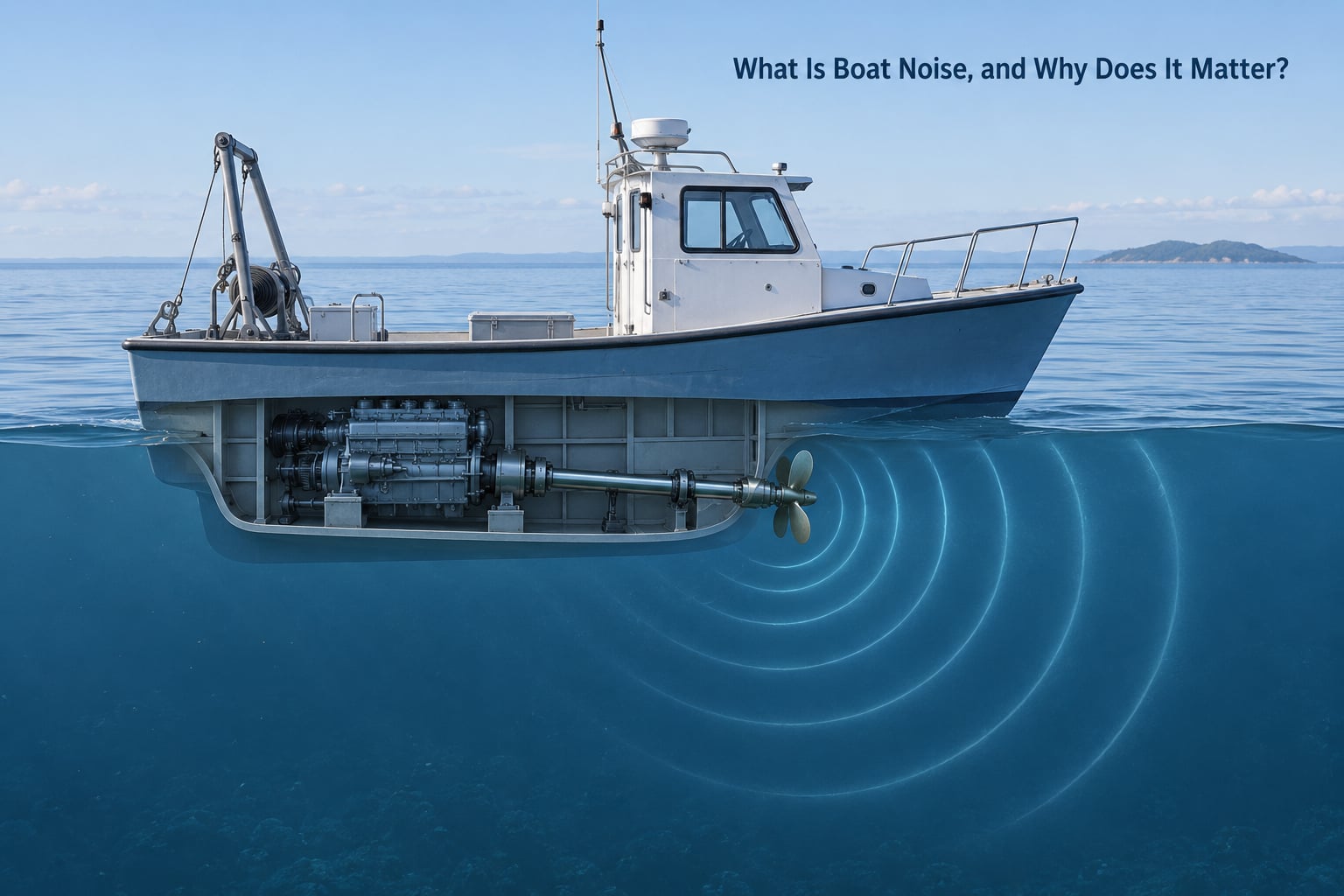
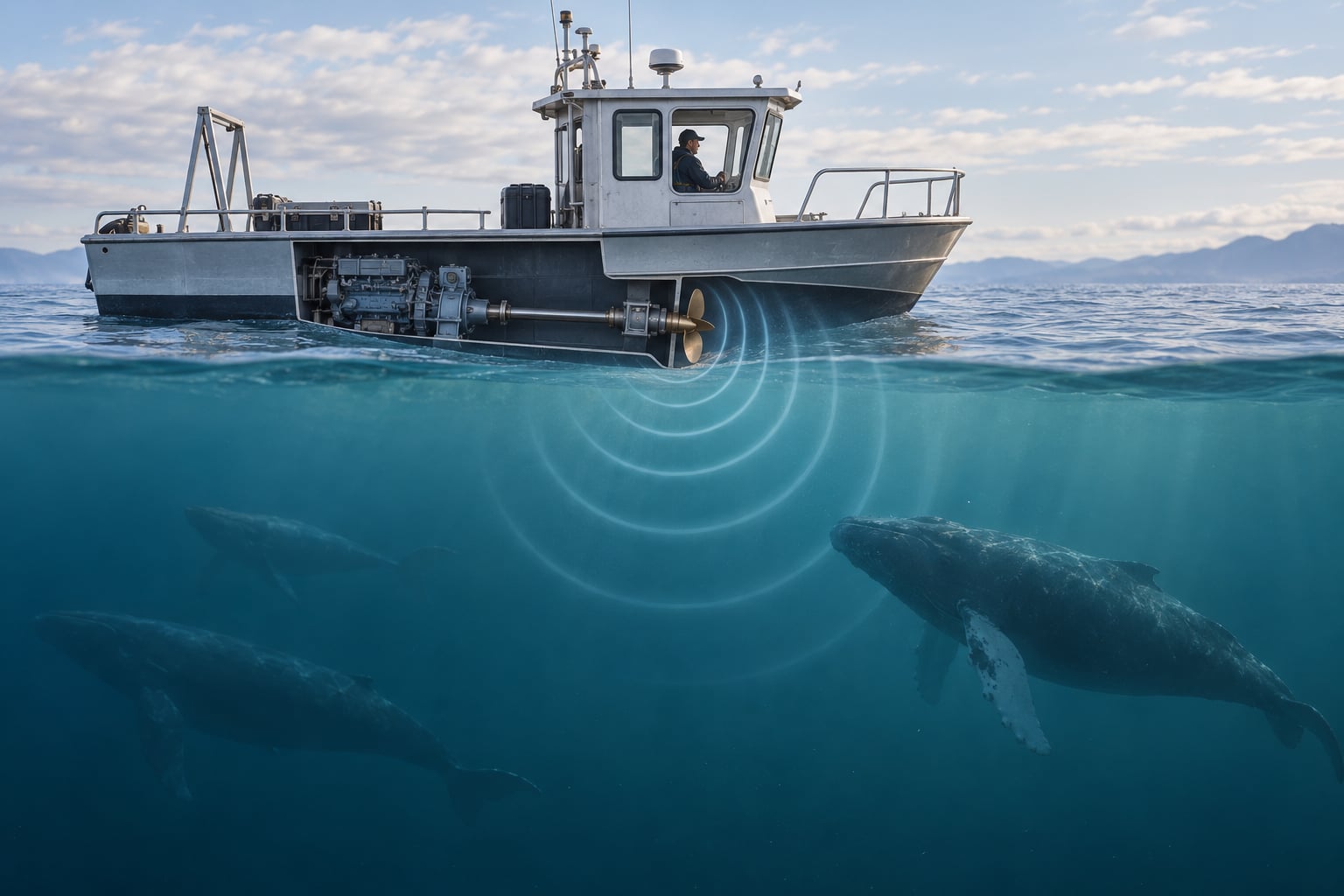
Boat noise is the underwater sound a vessel radiates from its engine, propeller, shaft, hull and electronics. The dominant source in small craft is usually the propeller, not the engine block. That surprises people, and it is the single most useful fact for anyone trying to quiet a boat.
Two mechanisms generate most of it. Propeller cavitation happens when the propeller pushes harder than it can, so bubbles form and collapse in the blade pressure wave, producing broadband noise with strong low-frequency energy. Machinery and shaft tones add narrowband frequencies on top of that broadband hiss.
An underwater decibel number is not an everyday decibel number
Underwater sound pressure is measured in decibels referenced to 1 microPascal, written dB re 1 µPa. A standard acoustic microphone measures relative to 20 microPascal in air. The references sit six orders of magnitude apart, so an underwater figure and an airborne figure are not interchangeable numbers.
Most published comparisons of a jet engine at 190 dB or sonar systems above 230 dB are airborne figures being used next to underwater ones, which makes them useless for reasoning about a boat. If a source quotes an underwater level without the reference pressure, the number is not usable.
Working practice at hydrophone deployments and monitoring stations is to report dB re 1 µPa with measurement distance, depth, hydrophone sensitivity calibration and vessel operating state, usually alongside spectral density in dB re 1 µPa per Hz. Without those, comparisons between vessels are not real comparisons.
Why boat noise reaches further than it looks
Sound moves about 1500 metres per second in seawater, roughly four and a half times faster than in air, and it loses far less energy along the way, especially at low frequencies. A 100 Hz tone can propagate hundreds of kilometres in favourable conditions.
That means the affected area is not the visible wake. A slow-moving boat can be the loudest thing in an animal’s acoustic environment for a much bigger radius than its hull suggests, which is why animals react to engines that have not visually appeared yet.
How Marine Mammals Are Affected by Boat Noise
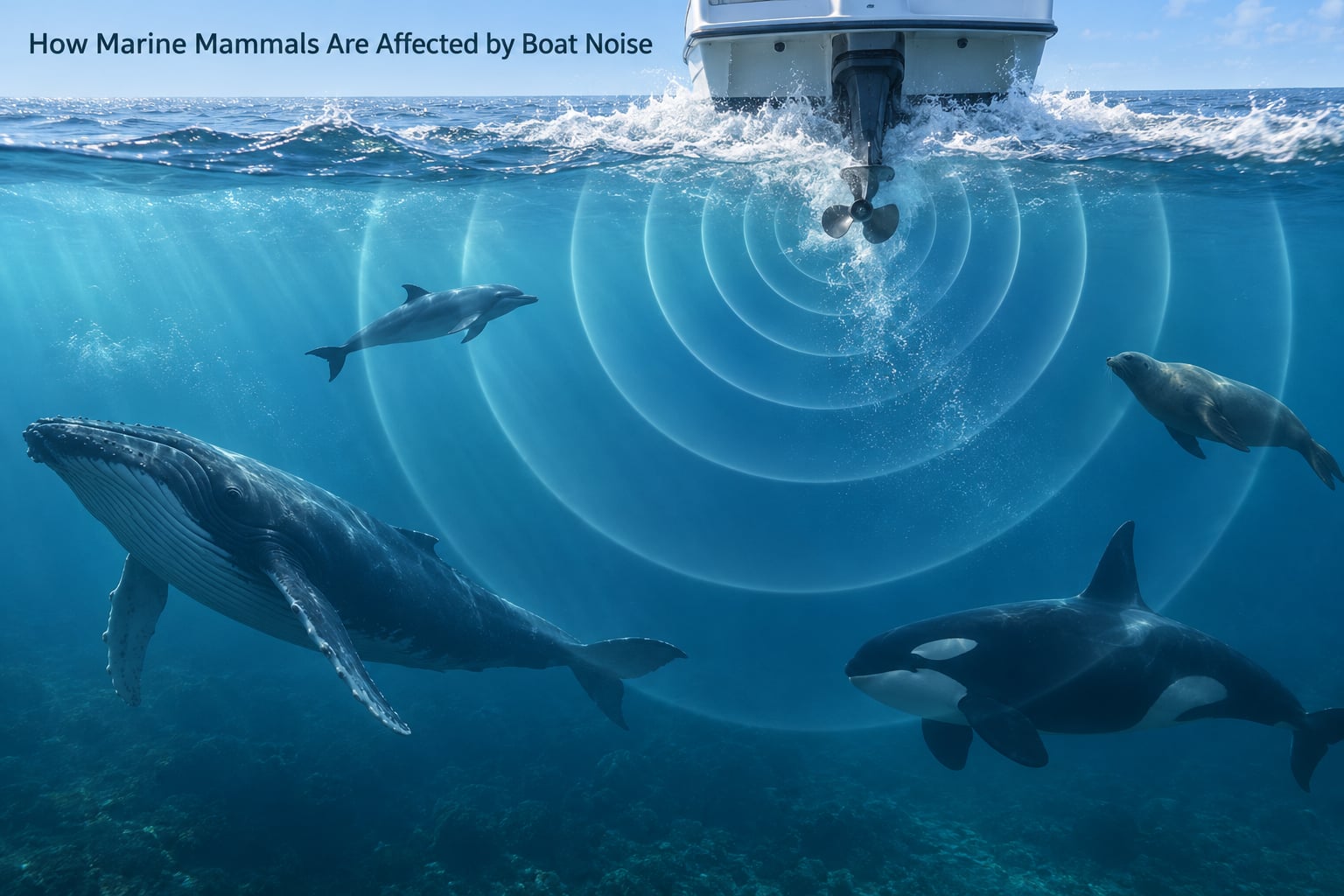
Directly: noise masks communication, interferes with hunting, affects physiology and hearing, and moves animals away from places they need. Here is each pathway with the measurement that anchors it.
1. Communication masking
Masking is the most certain effect and the least discussed. A call has to be detected against background noise, so a vessel raises the noise floor and a quieter call becomes undetectable. Groups that coordinate acoustically lose the ability to stay together without spending more energy on it.
2. Foraging interference
Noise hides prey echoes and the environmental cues predators use to find food. Tennessen and colleagues reported in Global Change Biology in 2024 that male killer whales missed prey when vessel noise masked their listening range, while females gave up foraging altogether during the exposure. Same noise, different cost.
3. Hearing damage and stress physiology
Loud or long exposures can raise hearing thresholds temporarily, and repeated exposure raises the chance of lasting loss. Chronic disturbance also drives the stress axis, and studies that measure faecal or blood hormones alongside behaviour consistently find elevated stress markers in animals exposed to vessel traffic.
4. Displacement and collision risk
Animals often leave an area rather than tolerate the sound, which pushes them into unfamiliar habitat with higher predation risk and thinner prey. The flip side is the one boaters see: animals surfacing beside an idling stern often cannot hear the boat over its own engine.
Which Marine Mammals Are Most Vulnerable?
Vulnerability is not one ranking. It depends on where an animal’s hearing is tuned, how much of its life depends on sound, whether its population is already small, and whether vessel routes overlap its habitat. The table below groups the evidence.
| Group | Primary acoustic dependency | Most documented effect of vessel noise | Evidence anchor |
|---|---|---|---|
| Baleen whales | Low-frequency communication over long distances | Call masking, reduced feeding time, displacement from feeding grounds | Foraging-interference work on killer whales, Global Change Biology 2024 |
| Toothed whales and porpoises | High-frequency echolocation plus mid-frequency social calls | Click detection range cut by broadband vessel noise at several hundred metres | Harbour porpoise auditory evoked potential study, Aarhus University, 2026 |
| Manatees | Low-frequency hearing, shallow-water use | Altered movement and reduced use of shared shallow habitat in noisy channels | Channel and vessel traffic monitoring literature |
| Pinnipeds | Underwater hearing plus aerial calls at haul-outs | Vigilance and displacement from boats approaching resting sites | Australian fur seal response to motorboat noise, PLOS ONE |
| Cephalopods, for contrast | Statocyst organs detect particle motion and pressure | Temporary deafness after short exposures to engine noise | Hummingbird bobtail squid study, Frontiers in Marine Science 2022 |
Note the last row. Squid are not mammals, and they matter here because they show the effect is a physical one, not a quirk of whale behaviour. Hearing damage from a boat has been measured in an invertebrate.
What Frequency and Duration Changes the Impact?
What matters is overlap and dose. Boat noise is broadband, so it covers much of what animals use, but the severity changes with frequency content, received level, duration and whether the exposure is continuous or repeated.
| Source characteristic | Typical frequency content | Exposure pattern | Likely consequence |
|---|---|---|---|
| Displacement diesel at idle | Broadband, strong low-frequency content | Continuous, near field | Strong local masking, close-range habituation pressure |
| Planing hull at speed | Broadband, rising with speed | Sustained, larger footprint | Wider masking radius, higher received levels |
| Propeller cavitation | Broadband with tonal components | Worst during acceleration and hard manoeuvring | Peak broadband level at close range |
| Slow transit under 7 knots | Narrower low-frequency band | Sustained but low level | Materially reduced radiated sound energy |
| Repeated short passes | Varies | Pulsed, cumulative | Interference to feeding bouts and call bouts |
| Slow-speed zone transit | Reduced | Sustained at low level | Measurable behavioural benefit in resident killer whale populations |
The time dimension matters just as much. A single pass leaves a temporary signature. Twenty small vessels cycling through a tight corridor all afternoon leave a continuous one, and continuous exposure is where temporary threshold shift becomes a plausible pathway to permanent loss.
Timelines and reversibility, roughly:
| Impact type | Timescale | Reversible? |
|---|---|---|
| Detection failure on a single call | Seconds | Yes, immediately |
| Abandoned or shortened feeding bout | Minutes to hours | Yes |
| Temporary threshold shift | Hours to days | Usually, with quiet recovery |
| Behavioural displacement from a site | Days to seasonal | Often, if the source stops |
| Permanent hearing loss | Chronic exposure | No |
| Population-level recruitment decline | Years to decades | No, on human timescales |
How Do Scientists Measure Underwater Noise?
The chain runs from the hydrophone to the animal, and every link adds uncertainty. Knowing the method tells you how much weight a claim deserves.
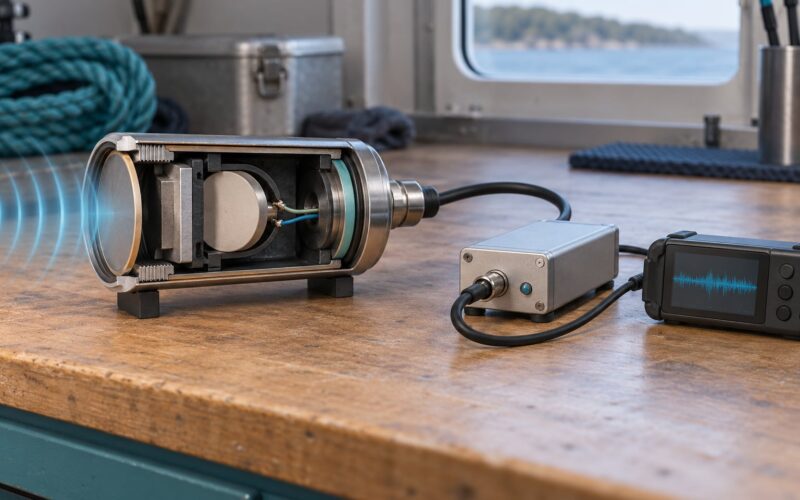
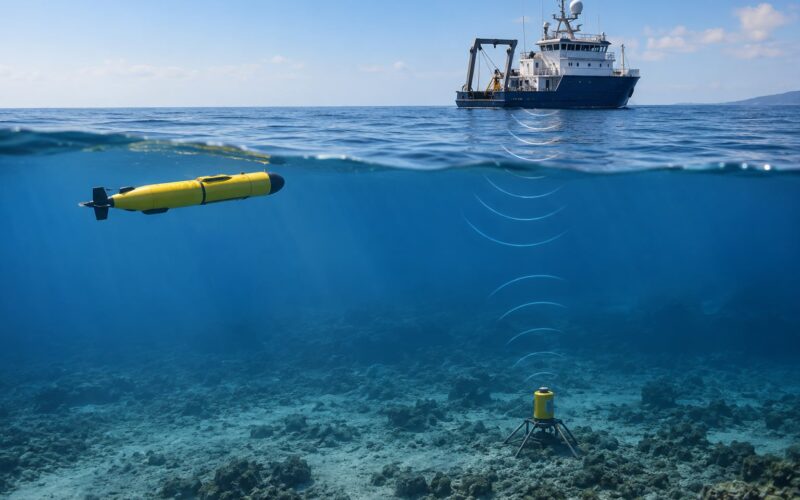
Hydrophones convert water pressure into an electrical signal. Deployed hydrophones sit on the seabed, on a mooring or on the hull of a vessel; they record raw audio for later analysis, which is passive acoustic monitoring. Calibrated systems with documented sensitivity and sampling rate are the only ones whose numbers can be compared with another dataset.
Shipping and small-craft studies then classify vessel type, speed and operating state from the recordings themselves, often cross-checking with AIS transponder data. Broadband levels are paired with spectral densities and third-octave band levels, because a single average level hides the frequency content that decides whether a call is masked.
For the animal side, researchers use hydrophones on a tag alongside animal-borne accelerometers to measure received levels at the animal, not at the surface, which is the only way to get a true exposure figure.
Physiological measurement is more invasive and less common. Auditory evoked potentials measure the electrical response of the auditory system to clicks, which gives a threshold estimate in a trained or temporarily captive animal. That is how the 2026 harbour porpoise work concluded that high-frequency vessel noise masks at several hundred metres, with temporary threshold shifts appearing rarely. Stress work typically pairs behaviour with faecal or blood hormone assays.
Key sources for the claims in this article include Tennessen and colleagues on vessel noise and killer whale foraging in Global Change Biology in 2024, the harbour porpoise masking work out of Aarhus University published in early 2026, the bobtail squid exposure study in Frontiers in Marine Science, the Australian fur seal motorboat study in PLOS ONE, and the OSPAR biodiversity series on anthropogenic underwater sound. Productive entries into the field literature include NOAA Fisheries resources, the Hydrophone and Pinger data portals and OSPAR Commission assessments.
Can Boat Noise Cause Hearing Damage or Death?
Yes, under the right conditions, and the evidence is stronger than most public writing implies. It is also easy to overstate, so the honest answer has three parts.
First, hearing damage is documented. A 2022 study exposed hummingbird bobtail squid to about 15 minutes of noise from an idling diesel engine at 150 dB, and the animals lost hearing for hours before recovering. That is a temporary threshold shift in a short exposure, in a species with entirely different hearing anatomy.
Second, the 2026 porpoise work found the opposite pattern for small craft noise. Masking was near-certain, temporary threshold shifts were rare, at several hundred metres from large cargo vessels and fast recreational craft. Two studies, two species, two different acoustic systems, no contradiction once you stop treating the outcome as a single number.
Third, direct mortality from boat noise is rare and hard to attribute. The clearest mass-events in the record involve military sonar rather than vessels, such as the 2000 stranding of beaked whales in the Bahamas after a naval exercise. That does not make vessels harmless; it means the pathway to death is usually cumulative, and it runs through foraging failure, chronic stress and collision risk rather than a single loud moment.
Avoid the two flat claims in either direction. Boat noise is not harmless because animals eventually habituate, and it is not lethal at any distance because it is a machine. Acute exposure and cumulative exposure are different problems with different thresholds and different fixes.
How Can Boats Reduce Their Noise Impact?
The ranking below is by measured effect size, not by how much effort it takes. A 10 percent speed reduction is widely reported to cut radiated underwater sound energy by roughly 40 percent, which is why slow-speed zones show measurable behavioural benefit for resident killer whale populations off British Columbia and Washington.
- Slow down, especially near animals and in sensitive habitat. Speed governs propeller loading, and loaded propellers cavitate. This is the single largest lever most operators have.
- Hold a real distance and give animals a clear path. A consistent, slow approach at a wide angle produces less noise and a better observation than a fast close pass.
- Cut idle time. An idling engine at the stern is often the loudest thing in a bay. Minimise idling near groups, and shut down when anchored to watch.
- Avoid abrupt manoeuvres. Hard throttle, rapid turns and planing up trigger cavitation and tonal noise spikes.
- Keep the hull and propeller in good order. A damaged or fouled propeller, a bent shaft or a rough hull surface all raise noise. This is the mechanical fix with the clearest payoff per hour of work.
- Choose quieter propellers and maintained gear. Where a refit is planned, propeller design and hull condition matter more than engine labelling.
- Plan routes around sensitive habitat and season. Routing outside a slow-speed zone or outside peak feeding periods reduces exposure without slowing anyone down.
Follow the regional rules where you operate, including slow-speed zone limits and published viewing guidelines, and log what you did. A pass log with speed, distance and duration is the raw material for every serious study in this field.
What Should Researchers and Boaters Document?
Good records turn anecdote into evidence. Whatever your role, the same core fields apply.
- Vessel type, engine and propeller configuration, and hull condition.
- Speed in knots, plus throttle changes and any planing.
- Distance to the animal or group at closest approach, estimated or measured.
- Duration of exposure and whether the vessel idled, transited or manoeuvred.
- Species, group size and age class if visible, including calves.
- Behaviour before, during and after: surfacing intervals, travel direction, calling, feeding attempts, approach or avoidance.
- Habitat context, depth and distance from shore or a shipping route.
- Sea state, weather and any concurrent source such as construction or another vessel.
- Sound measurements, if you have them, with the reference pressure and the instrument calibration.
Record the time too, and note the observer. Behavioural counts from one person watching from a moving platform are useful; the same counts from two observers with a stated protocol are publishable.
Frequently Asked Questions
How far away can a whale hear a boat engine?
There is no single number, because detection depends on frequency, vessel noise level, depth and sea conditions. Broadband vessel noise has been shown to cut echolocation detection ranges for harbour porpoises at several hundred metres around large cargo ships and fast recreational craft. Low-frequency engine energy travels much farther than it looks, so a vessel can matter acoustically well before it appears visually.
Do whales get used to boat noise?
Partly, and the partial part is the problem. Repeated exposure can produce habituation, a reduced behavioural response, but that is not the same as no cost. Animals that stop reacting still face masked prey cues, still spend energy, and some show increased sensitivity rather than reduced. OSPAR and peer-reviewed reviews both note that habituation can coexist with cases of heightened sensitivity after repeated harassment.
Does slow speed really reduce underwater noise?
Yes, and the effect is larger than most people expect. A widely cited estimate puts the reduction in radiated underwater sound energy at roughly 40 percent for a 10 percent cut in speed. That is why slow-speed zones off British Columbia and Washington show measurable improvements in how resident killer whales behave around vessels.
Why do dolphins approach boats if the noise hurts them?
Most often because they cannot hear the boat. Dolphins surfacing beside an idling stern are usually responding to a vessel whose own engine noise masked the approach. That is a symptom rather than a sign of comfort, and it is the same loss of avoidance behaviour that raises collision risk.
What marine mammal calls are most easily masked by boats?
High-frequency echolocation clicks from porpoises and toothed whales are the easiest to bury, because broadband vessel noise carries strong energy into the band those animals rely on. Low-frequency baleen whale calls overlap the engine and propeller band, so they are masked too, just at greater distances because low frequencies propagate so much further underwater.
Does boat noise cause whale strandings?
Directly attributed strandings from vessel noise alone are rare, and the well-documented mass events involve military sonar rather than boats, such as the 2000 Bahamas beaked whale stranding. The ordinary risk from vessel noise is cumulative: lost feeding time, chronic stress, displacement into risky habitat and a higher chance of being struck.
Start with speed. Slowing down, holding distance and cutting idle time cost almost nothing, and they do more for the animals outside your hull than any other change available to a boat operator. Log what you did, and the next vessel in the water starts with better data than this one had. For 2026 and beyond, treat every pass as an acoustic event, because under the surface that is exactly what it is.