Dispersants are chemicals applied to an oil slick to accelerate natural dispersion. Their surfactants reduce the tension at the oil-water interface, which lets breaking waves stretch and pinch the slick into droplets that enter the water column and dilute. They move oil away from shorelines. They do not remove it.
Short version of how dispersants work on oil spills: they make oil easier to break up, and breaking up is only useful when the water underneath can carry the resulting droplets away from where people and wildlife are.
I have spent a lot of time reading the response literature on this topic — the EMSA manuals, the 2005 National Research Council report, the Ohmsett wave tank work out of New Jersey — and the single biggest source of confusion is the word “clean.” Nobody disperses a slick to make the water look nice. They do it to change where the oil goes next.
Table of Contents
- What Are Dispersants Used for in Oil Spill Response?
- How Dispersants Work on Oil Spills
- What Chemicals Are Commonly Used?
- What Happens to the Dispersed Oil?
- When Are Dispersants Most Effective?
- How Is a Dispersant Treatment Applied?
- Environmental Benefits and Risks
- How Effective Are Dispersants?
- Dispersants vs. Other Oil-Spill Response Methods
- Key Takeaways for Understanding Spill Response
- Frequently Asked Questions
- Do dispersants remove oil from the environment?
- What types of oil can be chemically dispersed?
- Does dispersing oil make the spill disappear?
- Are oil-spill dispersants harmful to marine life?
- When do responders use dispersants instead of booms and skimmers?
- Can dispersed oil come back to the surface or shore?
What Are Dispersants Used for in Oil Spill Response?
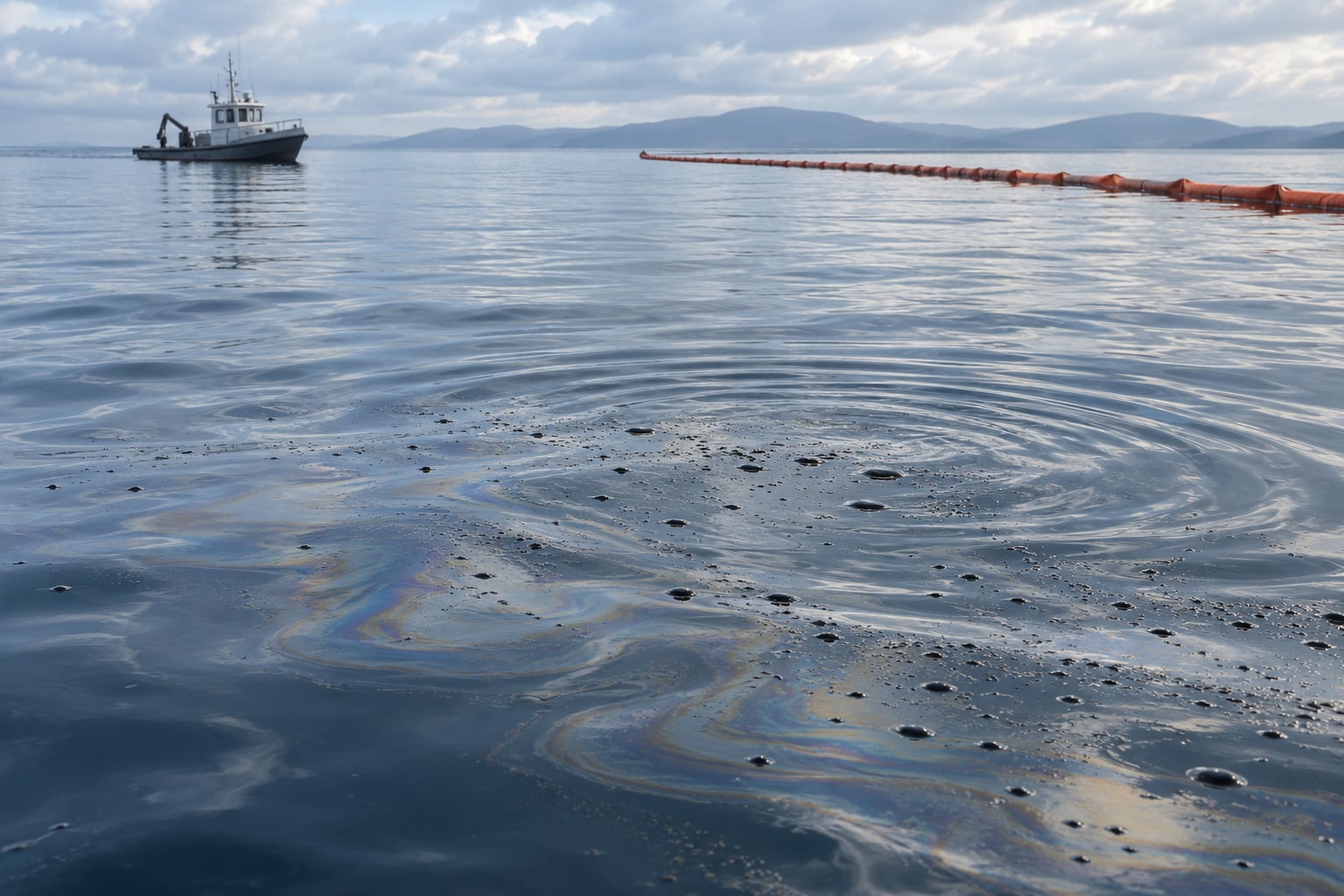
Dispersants are used to move oil out of the surface layer and into the water column before that oil reaches a coastline. Shoreline contact causes most of the long-term ecological and economic damage from a spill, so a response coordinator will accept a dilute subsurface plume in exchange for protecting a marsh.
That is the whole objective, and it is worth being blunt about it because the trade is not “clean water versus dirty water.” It is “a contained, monitorable plume in open water” versus “a thick band of oil that strands on tidal flats and beaches and then has to be dug out by hand.”
Dispersants are one item in a longer list of countermeasures, and the five are usually taught together as the 5 C’s: containment (booms), control (herding agents that thicken the slick so it can be gathered), collection (skimmers and absorbents), combustion (in-situ burning), and chemical dispersion.
Compare that to the alternatives:
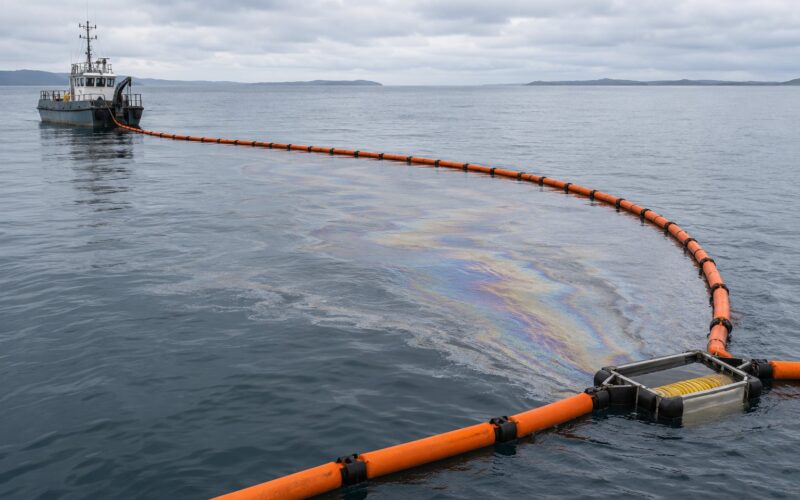
- Booms hold oil on the surface and stop it spreading. They work in calm, shallow, sheltered water and fail quickly in current or open sea.
- Skimmers recover oil physically, but they only capture what is in the top few centimetres at the surface, and they are slow relative to the volume of a large release.
- Absorbents soak up small volumes of oil. They are useful for pockets and slicks around vessels, not a subsea blowout plume.
- Natural degradation is the baseline outcome if nothing is done. Evaporation, dissolution, emulsification and biodegradation all remove some oil, and none of them respect a shoreline.
Dispersants get chosen when the volume of oil is larger than any recovery capability, when the oil is moving toward a sensitive shoreline, and when the sea state is doing the physical work that the chemical cannot do alone.
How Dispersants Work on Oil Spills
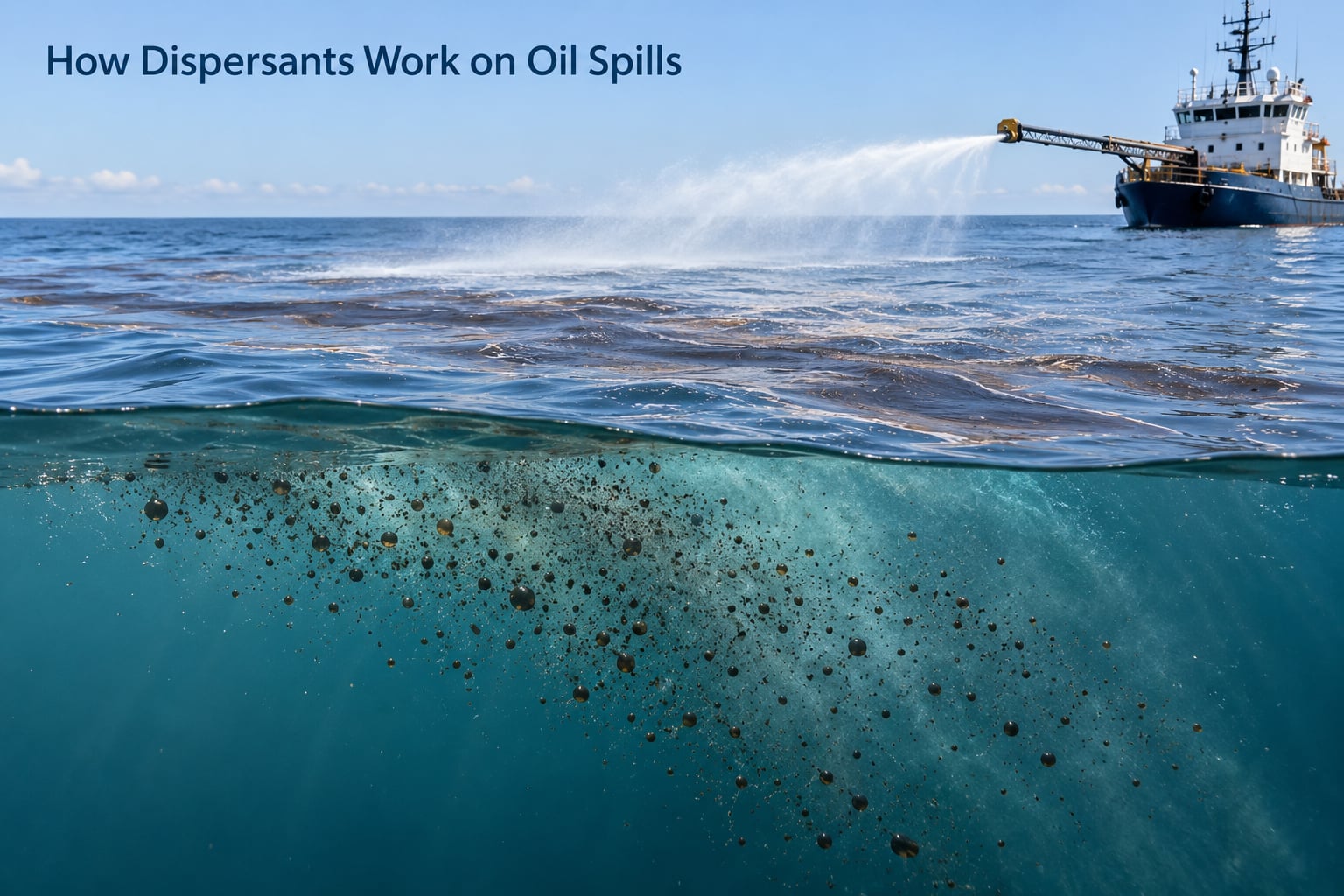
The mechanism is a five-step process, and every step after the first depends on wave energy that the responder does not control.
- Surfactant molecules reach the oil-water interface. A dispersant is a liquid formulation containing surfactants in a solvent. The solvent carries the surfactant into contact with the slick and into the thin water film beneath it, so the molecules can migrate to the boundary between oil and water.
- Interfacial tension drops. The surfactant molecules pack into the boundary layer with their oil-loving ends in the oil and their water-loving ends in the water. That packing weakens the surface between the two phases, so the slick becomes far easier to deform.
- Waves and turbulence stretch the slick. Wind waves break, and the resulting turbulent eddies pull the softened oil film outward. The film necks down into filaments, then into a curved dumbbell shape.
- Droplets pinch off and enter the water column. The thin neck in the dumbbell breaks. Droplets separate from the slick and are carried downward by the same turbulence, producing a characteristic droplet size distribution rather than random sizes.
- Dilution and fate in the mixed layer. Currents and turbulent diffusion spread the droplets across a very large volume. That dilution, not any chemical reaction, is what reduces the immediate concentration of oil in the upper water column.
Why dispersants need waves to work
Surfactant alone does nothing to a calm slick. The energy to deform and pinch the film comes from the breaking-wave energy dissipation rate in the upper ocean, and when that energy falls below what is needed to overcome the interface tension, droplets stop forming.
This is the practical reason dispersant operations are scheduled around the forecast. Applied on glassy water in calm conditions, a correct product at a correct dose can produce almost no measurable dispersion. The same product on the same oil in a moderate sea state behaves completely differently.
Chemical dispersion versus mechanical dispersion
Two different things break up oil, and the public conversation constantly merges them. Mechanical dispersion is the work of waves, boat wakes and propellers on untreated oil; it is a purely physical breakup. Chemical dispersion is the surfactant-assisted version, and the surfactant changes the threshold energy needed for the breakup to happen at all.
Neither one is “removal.” The difference matters for monitoring, because in a mechanical-dispersion scene the oil is simply broken into droplets that rise again, while chemically dispersed droplets stay suspended long enough to dilute and biodegrade.
What Chemicals Are Commonly Used?
Almost everything in operational use is a surfactant blend in a light hydrocarbon solvent, and product selection depends more on the oil and the operating conditions than on marketing.
| Type or family | What it is | Defining characteristic |
|---|---|---|
| Concentrate dispersants | Surfactant-solvent concentrates applied neat or pre-diluted, such as the Corexit 9500 and 9500A family | Work across a wider range of oils and sea states, including colder and more viscous oil, when dosed properly |
| Ready-use dispersants | Pre-diluted formulations, including the Corexit 9527A and EC9527A family | Simpler and safer to handle; can be less effective against the most viscous or heavily emulsified oil |
| Alternative concentrates | Non-petroleum-derived formulations such as Goldenseal, built on biobased solvents | Developed in part to answer concerns about the toxicity of traditional solvent systems |
| Herders | Oleophilic polymers that thicken and channel the slick rather than break it up | A control tool, not a dispersion tool; used to move oil toward a collection zone |
Two formulation details explain a lot of the operational differences. First, the solvent does real work: it carries surfactant into the oil, and the EMSA manual describes it explicitly as helping surfactants penetrate into the oil. Second, application ratio matters more than people expect, and responders are instructed to stay within a defined band rather than adding “more to be safe” — over-dosing wastes product and pushes the system past the point where droplets re-coalesce efficiently.
Cold water and ice-covered water are the harder cases. Lower temperature raises viscosity, slows the chemistry, and restricts the mixing window, which is exactly the environment — the Arctic — where oil from a subsea release is hardest to reach and recover by other means.
What Happens to the Dispersed Oil?
Dispersion changes the oil’s form and location, not its mass. From the moment droplets separate, five fates compete, and any of them can dominate depending on the oil, the season and the water column.
- Dilution is the dominant short-term process. Turbulent diffusion and currents push droplets apart until concentrations fall below levels of concern.
- Dissolution removes the lighter soluble aromatic fractions, including some polycyclic aromatic hydrocarbons, into the water as dissolved compounds rather than droplets.
- Sedimentation occurs when droplets attach to suspended particles and form oil-mineral aggregates that are dense enough to sink. This is a real pathway, and the depth reached depends heavily on particle availability and turbulence.
- Biodegradation works on small droplets far better than on a thick slick, because the surface area available to bacteria is vastly greater. Whether it is net-accelerated remains genuinely debated.
- Re-coalescence and biota uptake go the other way. Droplets that meet again can merge into larger, resurfacing blobs, and organisms can take up hydrocarbons directly.
On the biodegradation question, the widely reported claim from the Gulf response was that dispersants suppressed the very oil-degrading microbial species they were meant to help, and that framing has stuck for years. The evidence is more mixed than the headline suggests, and it is still an open research question rather than a settled verdict.
The other correction worth making, because it comes up constantly: the claim that dispersant drove Gulf oil to around 1,200 metres is not supported. Depth of submergence is controlled mostly by ambient temperature, sea turbulence and the density of the oil itself, not by dispersant chemistry. Describe where the oil went, and the description should not depend on a chemical that is not that dense.
When Are Dispersants Most Effective?
Effectiveness is a function of timing, sea state, oil properties and distance to shore. Miss any one of them and the treatment can produce very little measurable dispersion.
The window of opportunity is the critical variable. Fresh crude is the easiest case. Over hours and days it weathers: volatile fractions evaporate, the surface water content rises, and a water-in-oil emulsion forms with water as the internal phase. Emulsified oil is far more viscous, resists droplet formation, and becomes almost impossible to disperse. The longer the response runs, the worse the product options become.
The other conditions that decide the outcome:
- Sea state. Moderate wind and breaking waves are needed to supply the energy that pinches droplets off. Flat water means no dispersion.
- Oil viscosity and pour point. Heavy fuel oil and bunker spills are much harder to treat than light crude, and cold water pushes every viscosity up.
- Water depth and flushing near shore. Dispersant is normally avoided in shallow, poorly flushed, low-energy environments, because that is where a dispersed plume is most likely to come back into contact with sediments or organisms.
- Distance to the nearest sensitive shoreline. The larger the buffer, the better the trade works.
That list is also the decision framework a Unified Command actually uses. If the oil is thick, the water is flat, and the tide is heading for a marsh, the answer is no — and a well-run response is defined as much by the treatments it declines as by the ones it carries out.
How Is a Dispersant Treatment Applied?
Application is a controlled, approved operation, not something improvised at sea. It runs from planning through delivery, monitoring and reassessment.
- Planning and authorisation. The response organisation sets objectives, models where the oil will travel, and approves the treatment with defined limits on dosage and volume. Regulator and Unified Command sign-off sits in front of the first drop.
- Delivery. Aircraft spray over the slick, vessel-based application from workboats, shoreline application where no vessel can reach, and subsea dispersant injection — SSDI — for deepwater leaks that feed a plume beneath the surface before it ever reaches a slick.
- Monitoring. Response teams use aerial and satellite oil-slick sensors to map the treated area, and NOAA’s SMART protocol sets the standard for measuring surface oil. Effectiveness is judged from the resulting droplet size distribution and percent dispersion, not from the volume sprayed.
- Reassessment. Teams check whether the treatment met its objective, whether the plume behaves as modelled, and whether further treatments make sense at all.
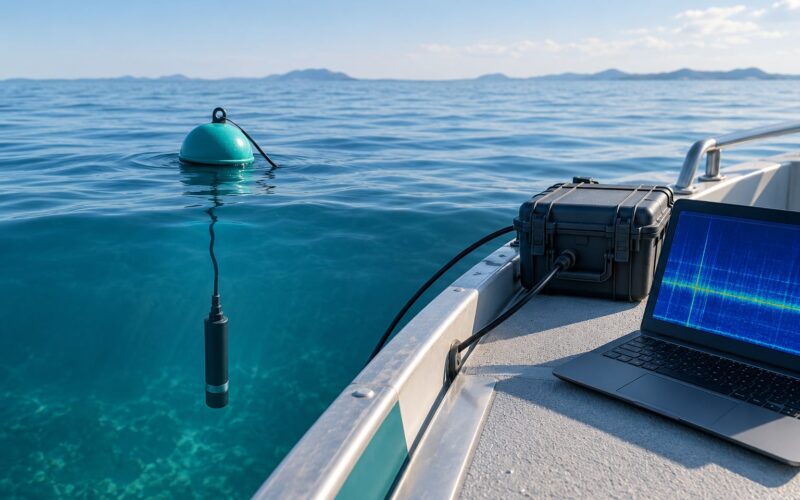
Sensor and robotics work has widened that picture considerably. Detecting and tracking a slick from the air has become far more reliable than it was two decades ago, and autonomous skimming systems now attempt the physical recovery that used to depend entirely on crewed vessels holding station. Dispersal decisions and recovery decisions are increasingly driven by the same instrumentation, and the sensors that map the slick also tell you whether the dispersant did anything.
Environmental Benefits and Risks
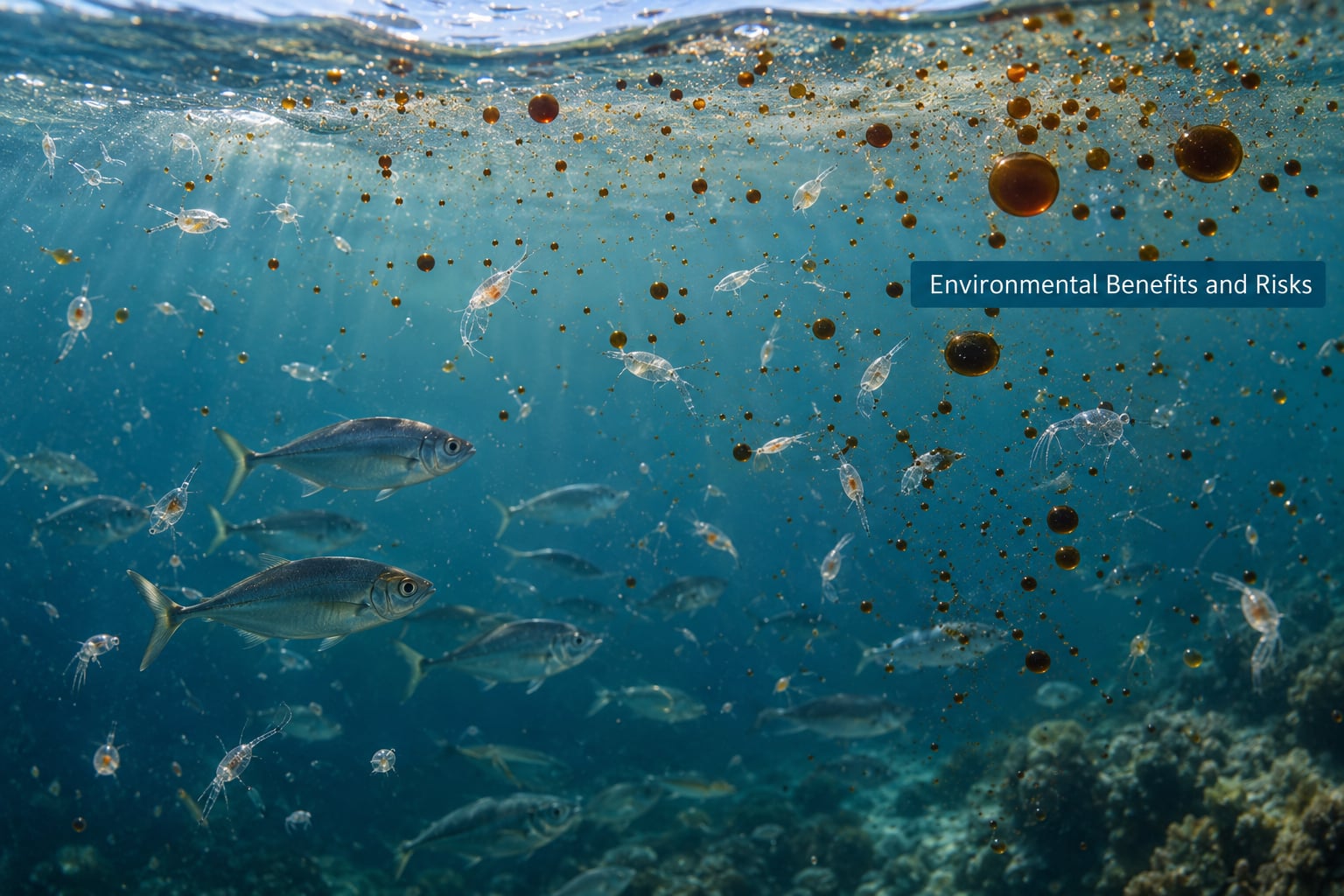
The argument for dispersants is a trade, and pretending otherwise does not help anyone. The benefit is reducing the volume and concentration of oil that reaches shore. The risk is that the same treatment moves that oil into the water column, where organisms meet it directly instead of encountering it as a shoreline deposit.
Toxicity has to be read comparatively, which is how the EPA framed it after the Gulf release: dispersed oil is generally less acutely toxic than the oil itself, because the same surfactant chemistry that coats the droplets also reduces the bioavailability of the most toxic fractions. On that framing, treating oil in place can reduce harm rather than add it.
The unresolved parts deserve equal billing. Dissolved aromatic compounds are bioavailable by definition, and chronic and sub-surface effects are much harder to study than acute mortality tests on a few standard test organisms. A treatment that moves a well-characterised surface problem into a poorly-characterised three-dimensional one deserves a monitoring plan attached to it, and in most real operations that plan does exist.
There is also the exposure question for responders themselves. During the Gulf response, workers reported symptoms consistent with chemical exposure, and the formulation chemistry is largely proprietary, which keeps the criticism pointed at ingredient transparency rather than at the mechanism. That criticism is fair. The mechanism is well understood even when the recipe is not published.
How Effective Are Dispersants?
Anyone quoting you a single percentage for dispersant effectiveness is simplifying past the interesting part. Effectiveness is measured differently depending on what you are trying to know.
At the bench, the Baffled Flask Test and the Swirling Flask Test put a known amount of oil and dispersant in controlled energy and count the droplets that form, producing a percent-dispersed value and a droplet size distribution. Those numbers are highly repeatable, which is also why they are easy to over-interpret: a flask is not a sea.
In the lab-tank category, facilities such as the Ohmsett oil spill response test facility run full wave tanks where breaking waves, temperature, salinity and oil type can be varied together. That is where energy dissipation thresholds and dispersion rates under real turbulence are established.
In the field, NOAA’s SMART monitoring protocol measures surface oil with aerial and satellite observation, and the comparison that matters is the treated volume against the recovered oil. Those are different quantities. Treated volume is what the aircraft covered; recovered oil is what came back in a skimmer or ashore. Only the second one looks like removal.
So the honest summary is: dispersants are effective within a well-defined operating envelope, and the envelope is bounded by sea state, oil state and time since release. Outside it, the same product in the same dose delivers almost nothing.
Dispersants vs. Other Oil-Spill Response Methods
No serious response picks one tool. The same operation typically runs booms in the shallows, skimmers in the recovery zone, burning on thick slicks where weather allows, and dispersant offshore on the parts that no vessel can reach.
| Method | Mechanism | What it does to the oil | Chosen when |
|---|---|---|---|
| Chemical dispersant | Surfactants lower interfacial tension so waves form droplets | Moves it into the water column, diluted | Large volumes, open water, sensitive shoreline in the path, moderate sea state |
| Boom and skimmer | Physical containment plus surface recovery | Removes it from the water | Sheltered, shallow, slow-moving oil near a recovery point |
| Herder | Oleophilic polymer thickens the slick | Concentrates it for collection | Thin slicks that skimmers can then work |
| In-situ burning | Ignition of a thick slick in place | Destroys a large share quickly | Thick oil, calm conditions, low toxicity and no human population nearby |
| Natural weathering | Evaporation, dissolution, emulsification, biodegradation | Slowly reduces and changes the oil | Always, and deliberately whenever treatment risk exceeds the damage being prevented |
The advantage and disadvantage pair is short enough to state plainly. Advantage: dispersants can move a large volume of oil away from a shoreline faster than any other countermeasure. Disadvantage: they do not remove the oil, they redistribute it into the water column where the consequences are harder to see and harder to bound.
Key Takeaways for Understanding Spill Response
How dispersants work on oil spills is a short mechanism with a long tail of conditions attached. Surfactant molecules lower the tension at the oil-water interface, breaking waves stretch the softened slick into droplets, and currents dilute those droplets through the mixed layer. The oil mass is unchanged at every step.
Three things follow from that. Dispersants are a shoreline-protection tool, not a cleanup product, and the people best placed to judge the trade are the response coordinators and regulators doing the modelling. Waves do the real work, so calm water makes treatment nearly useless. And the window closes fast: as oil weathers and emulsifies, the option that worked on day one stops working by day three.
If you take one practical rule from this, make it the question to ask of any dispersant claim, yours or someone else’s: what were the sea state, the oil state and the elapsed time, and what was measured afterwards? Without those four answers, the number means very little.
Frequently Asked Questions
Do dispersants remove oil from the environment?
No. Dispersants change the size, location and concentration of oil, not the quantity of it. The slick becomes a cloud of small droplets suspended in the mixed layer and diluted across a very large volume of water. Removal is something only mechanical recovery, burning and natural degradation do.
What types of oil can be chemically dispersed?
Light and medium crude oils are the easiest cases because they are fluid enough to form droplets. Dispersants are usually approved for crude oil, fuel oil, and oil products across a stated range of viscosities. Heavily emulsified or very viscous oil resists dispersion, which is why weathered oil is so much harder to treat than fresh oil.
Does dispersing oil make the spill disappear?
It reduces the visible slick and moves the oil below the surface, but it does not make the release vanish. Followed properly, the oil continues through dilution, dissolution, sedimentation, biodegradation, re-coalescence and uptake by organisms. What disappears is the concentrated surface layer, not the oil.
Are oil-spill dispersants harmful to marine life?
In context, less so than the oil they treat. Surfactant coating reduces the bioavailability of the most toxic oil fractions, and the EPA used that comparison when assessing Gulf response dispersants. Open questions remain about dissolved aromatic compounds and chronic, sub-surface effects, which is why treatment decisions require monitoring rather than assumption.
When do responders use dispersants instead of booms and skimmers?
When the volume of oil is far larger than recovery capability and the oil is moving toward a sensitive shoreline, usually in open water with enough wave energy to form droplets. Booms and skimmers are preferred in shallow, sheltered, slow-moving conditions where the oil can actually be caught. Most real responses run both at once in different zones.
Can dispersed oil come back to the surface or shore?
Yes, and this is why the decision is not simple. Droplets that fail to separate, or that re-coalesce, can resurface as tar balls, and droplets that attach to suspended particles can sink to the seabed and be remobilised by bottom currents. Responders weigh that risk against the shoreline damage they are trying to prevent, and avoid treatment in shallow, poorly flushed water for exactly this reason.
If you are researching this for a report or working alongside a response, go to the mechanism first: surfactant at the interface, waves doing the physical work, dilution doing the rest. Everything after that is condition-dependent. If you want to see the instrumentation side, this site’s coverage of marine sensors and ocean cleanup robotics picks up where the chemistry stops.