Here is how oil booms contain a spill, in short: the boom floats on the surface as a physical barrier, where a section above the waterline blocks oil moving across the surface, a hanging skirt blocks oil slipping underneath, and the enclosed pocket of water holds the slick in one place until skimmers or sorbents collect it. The boom does not clean the water itself, and that distinction shapes everything responders do next.
It is worth being blunt about the limits here, because boom sales pages rarely are. A boom is a containment tool, not a removal tool. Set it badly and oil drains underneath within minutes. Set it well and it holds a slick at a fixed point for days while recovery equipment works through it.
Table of Contents
- How Do Oil Booms Contain a Spill?
- What Are the Main Parts of an Oil Boom?
- What Types of Oil Booms Are Used?
- How Do Responders Deploy an Oil Boom?
- How Effective Are Oil Booms in Different Conditions?
- Why Can’t an Oil Boom Remove All the Oil?
- How Do Responders Monitor a Contained Oil Slick?
- How Do Oil Booms Contain a Spill Without Causing More Harm?
- Frequently Asked Questions
- Conclusion
How Do Oil Booms Contain a Spill?
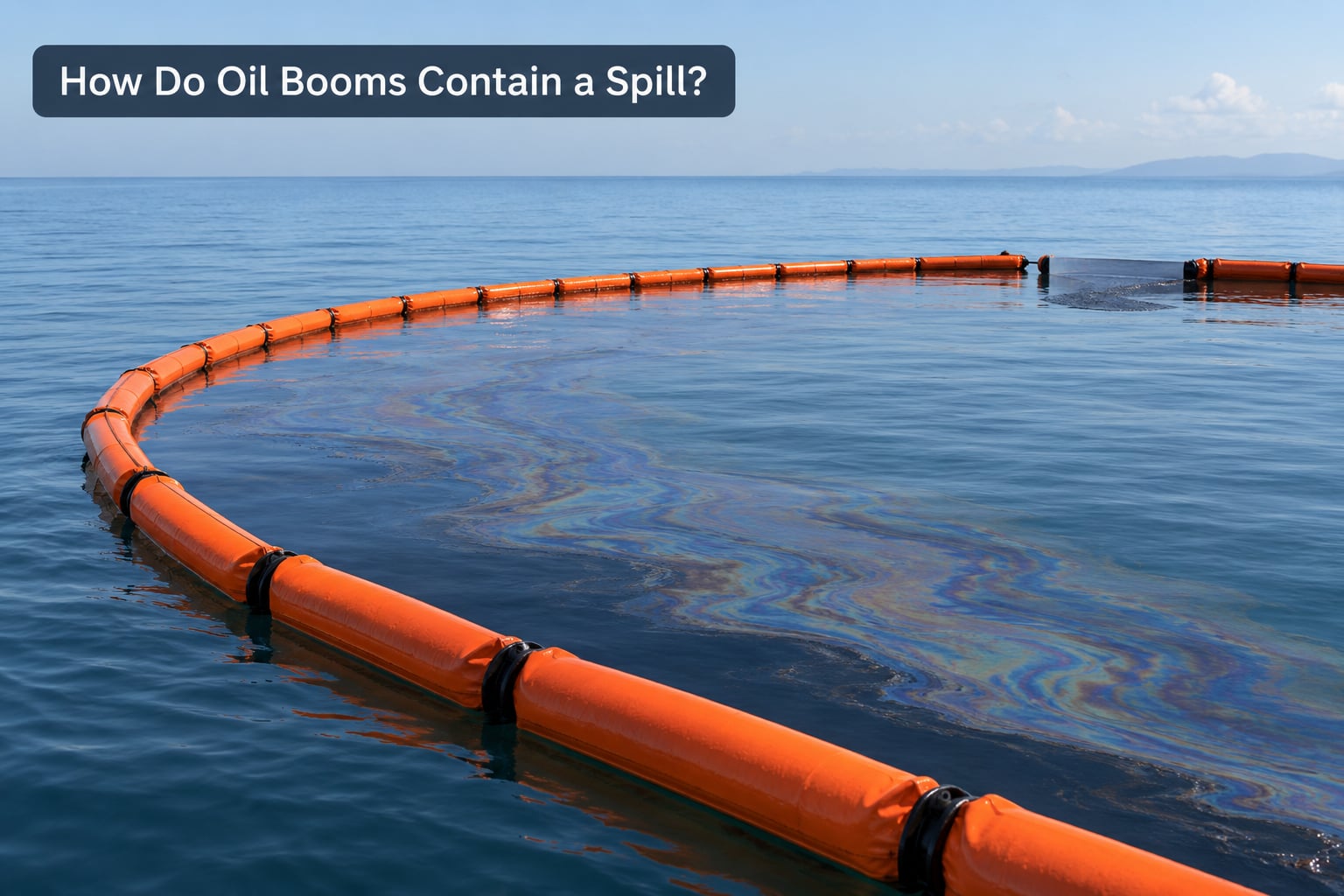
How oil booms contain a spill comes down to two barriers working as one. Above the waterline sits the freeboard, a strip of fabric that stops surface oil and wave action passing through. Below the waterline hangs a weighted skirt that stops oil traveling underneath. Together they form a floating wall that oil cannot cross without going around or through it.
Oil on water forms a thin surface film, usually with heavier fractions mixed into the top few centimetres. A boom intercepts that film and redirects it. It is doing the same job as a boom in a harbour or a fence in a field, only the medium moves.
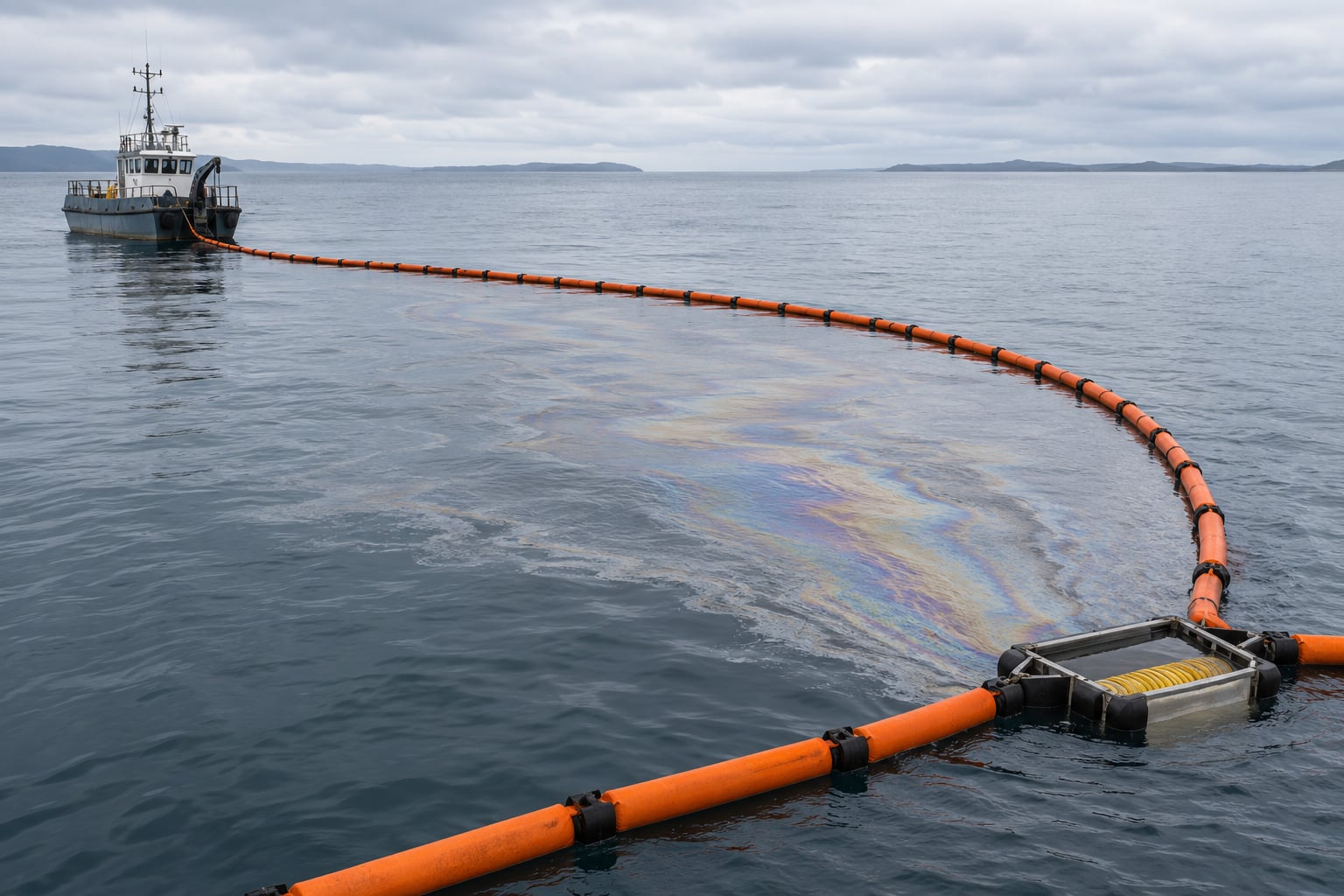
Responders rarely set a boom in a straight line. Doing so lets oil run down the sides. Instead they deploy in a C shape around the downcurrent side of the slick, or a V shape when the slick is drifting and the geometry is less predictable. Anchors at each end pull the line into a catenary so the boom bows downstream rather than sitting flat and slack.
That shape does two useful things. It holds the slick instead of merely delaying it, and it concentrates the oil into a narrower pocket where a skimmer head can be positioned. The current and wind set the shape; the crew adjusts it as those change through the day.
What Are the Main Parts of an Oil Boom?
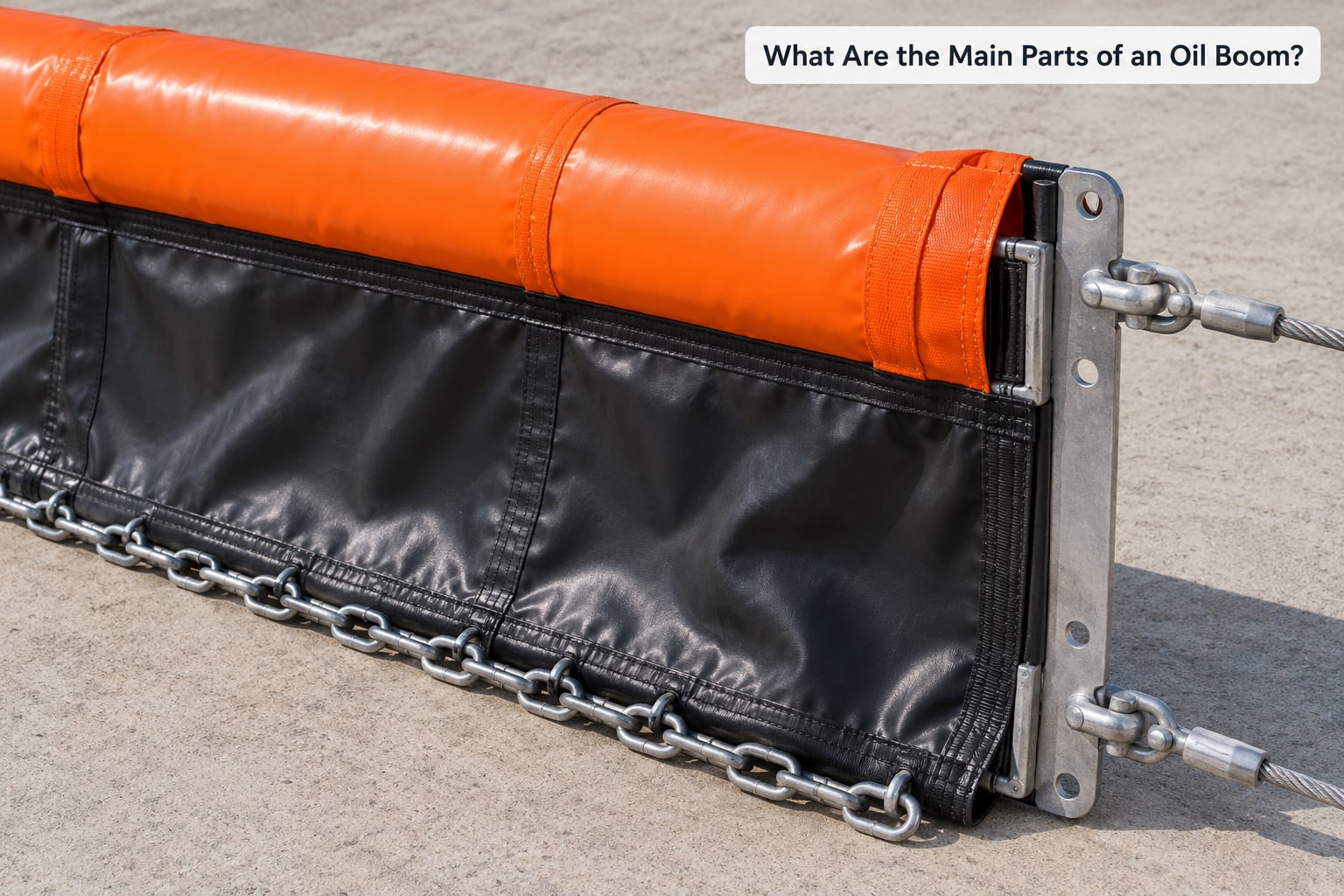
Every boom, from a 15-metre harbour unit to a 300-metre offshore section, is assembled from the same handful of parts. Each one has a job, and when a job fails the boom stops containing.
| Part | What it does | Notes |
|---|---|---|
| Floatation section | Holds the boom at the surface | Chambers, solid floats or inflatable sections; spreads the load along the length |
| Freeboard | The part above the waterline | Stops surface oil, wave splash and wind pushing under the boom |
| Skirt or draft | The hanging section below the waterline | Weighted along the bottom edge to stop oil passing underneath |
| Ballast chain | Keeps the skirt vertical | Sets the draft; too light and the skirt lifts, too heavy and it drags |
| Tension member | Resists the pull of current | Top tension cable with a stiffener, usually chain or wire |
| Connectors | Join boom sections together | Usually quick-release with a spare shackle on each joint |
| Anchor and mooring | Holds the ends in place | Danish hooks, flukes or pile moorings sized for the current and depth |
The freeboard and the draft are a balance. Too little freeboard and a wave crosses the top; too little draft and oil slips under the skirt. Too much of either and the boom becomes heavy, awkward to tow and harder to tension properly.
Connectors deserve more attention than they get. In the field a boom usually fails at a joint before it fails anywhere else, which is why crews carry spare shackles and check every connection during deployment.
What Types of Oil Booms Are Used?
Boom designs split along two axes: where they work, and whether they only contain or also absorb.
Harbor and port booms are short sections of 10 to 30 metres with connectors for quick stringing together. They are designed for calm or lightly sheltered water and for a response that starts within minutes of a report.
Lake and pond booms are usually the simplest units, with flat or shallow-draft construction suited to still water and slow currents. They are common around fuel docks and inland terminals.
River booms have a deeper draft and a lot of freeboard, because rivers are narrow, fast and full of debris. They get deployed in a V or an angled line pointing toward a collection point, and they get replaced often, since abrasion on rocks and pilings is constant.
Offshore or ocean booms come in long sections of 50 to 100 metres or more, with heavy ballast and high freeboard to handle swell. They need a workboat, a crane and real crew discipline to get in the water at all.
Sorbent booms are the odd one out. Their media is oleophilic and hydrophobic, so oil is drawn into the material and held there rather than repelled. That makes them a recovery tool with a short lifespan; once saturated, they come out of the water for disposal or regeneration.
A few specialist designs round out the list: weir booms hold a thicker layer of oil at the surface for skimming and fill with water by design, fire-resistant booms support in-situ burning without melting, self-adjusting booms ride changes in water level, and ice-tolerant booms are built to survive in cold water where the boom itself can freeze in place.
How Do Responders Deploy an Oil Boom?
Deployment starts before anything touches the water. The incident lead confirms the spill source is stopped, sets a safety zone, and sends someone to look at the slick from height. Booms deployed blind waste the deployment and put crews in the wrong place.
The workboat then positions itself upcurrent of the slick and begins paying boom astern. One end is anchored first, then the line is streamed out in a controlled curve, and the far end is anchored. The crew tensions as they go so the boom trails at a shallow angle rather than straight across the flow.
After anchoring, crews check the freeboard and draft along the length by hand and by eye. A section sitting too high invites oil underneath; one sitting too low drags on the bottom. They also check for gaps at connectors and confirm the boom is not bridged, the slack bit where it hangs above the water.
A collection point is set at the apex of the C or V, which is where a skimmer, a vacuum head or sorbent boom attaches. Then the boom gets watched, because tide, wind and current will all move it during the operation.
None of this is a substitute for certified training. Boom handling is heavy, awkward work done close to a hazard, and equipment ratings, site-specific plans and legal duties differ in every jurisdiction. This is a description of the method, not a procedure to run with.
How Effective Are Oil Booms in Different Conditions?
Effectiveness depends far more on the environment than on the boom in the water. A given section can hold an oil slick indefinitely in slack water and fail within minutes in a fast current.
| Condition | What happens | Effect on containment |
|---|---|---|
| Slack or slow current | Boom holds its shape and the oil stays on one side | Best case; the pocket holds and recovery is steady |
| Fast current | Oil is pushed against the boom and drains under the skirt | Poor; containment drops sharply and the slick escapes downstream |
| Waves | Wave crests lift the boom and oil crosses the top | Overtopping; worse with high-frequency chop than with long swell |
| Wind-driven surface drift | Oil pushes sideways against the line | Reduces the effective current speed but still loads the boom |
| Shallow water | Bottom-mounted sections ground out and lose their shape | Works in shallows only with a sinker boom or a shoreline boom |
| Tides | The boom needs to rise and fall without losing tension | Requires a self-adjusting boom or a planned tensioning schedule |
| Boat traffic | Vessels push the boom and open gaps | Needs a controlled channel or exclusion zone |
| Debris | Logs and ice tear at connectors and abrade the skirt | High failure rate, especially on rivers |
| Thin or weathered oil | Sheen spreads faster and hides under surface ripple | Harder to see and harder to hold; containment is measured differently |
| Heavy viscous oil | Oil stays in thick patches rather than a thin film | Easier to contain but much harder to recover |
The practical lesson is that a boom belongs where the water is slow and the geometry is narrow. On a river, response teams sometimes decide a boom is the wrong tool entirely and move to booms placed upstream in a series, or to sorbent and manual recovery.
Why Can’t an Oil Boom Remove All the Oil?
A boom contains. It does not remove. There are three separate jobs, and confusing them is why some spill expectations get badly wrong.
Containment is the boom: holding the slick away from sensitive shoreline and in one place. Recovery is the equipment that actually takes oil out of the water, such as skimmers that pump recovered oil aboard, sorbents that absorb it, vacuum trucks on shorelines and manual collection of thick deposits. Cleanup is what happens to oil that has already reached the seabed, a marsh or a beach, which is a different set of tools again.
When oil gets past a boom it usually escapes in one of three ways. Drainage under the skirt is the common one: current pushes oil against the boom until enough pressure builds to force it beneath the ballast. Overtopping happens when wave height exceeds the available freeboard. Failure is the third, meaning a parted connector, a dragged anchor or a breach, usually caused by the first two over time.
Once the pocket holds, skimmers work through the concentrated oil and must keep pace with it. Sorbent booms and sorbent sheets mop up the residue in sheltered corners. Offshore, responders may also use in-situ burning to remove large surface volumes quickly, or dispersants that break oil into droplets for dilution, both of which trade contained oil for dispersed oil rather than eliminating it.
Response planning usually runs on the five C’s: contain, collect, confine, clean up and communicate. A boom covers the first one. Everything after it needs people, equipment and time.
How Do Responders Monitor a Contained Oil Slick?
Monitoring a contained slick is unglamorous and constant. Crews walk or boat the boom at intervals, look for sheen on the upstream side, check that the freeboard is still above the surface, and watch for bridged sections. Thickness and drift are noted, often on paper, because that record is what a regulator and a future planner will ask for.
Modern monitoring increasingly adds instruments. Slick-tracking drones give a fresh map every few minutes, and surface-following sensors can log temperature and flow that help crews anticipate where the oil will sit as the tide turns. The boom still does the containing; the instruments tell the crew whether the boom is winning.
That instrumentation only supports a response. Reading a slick, deciding when a boom has to be reset and replacing a torn section are all judgement calls made by trained crews working to an approved plan.
How Do Oil Booms Contain a Spill Without Causing More Harm?
A boom has its own footprint, and a responsible response weighs it. Anchorage lines cross channels and can cut off small craft. Booms drawn across a marsh can scrape vegetation. Sorbent booms that sit too long risk trapping animals and birds inside the material.
Marine mammals are a specific concern in some regions, since they can become entangled in a boom or its mooring lines. Most response plans address it with observation before deployment, daylight handling where possible, and monitoring of the line once it is in the water.
Navigational risk runs the other way too. A boom across a shipping channel has to be marked, guarded and sometimes opened for traffic, which introduces its own failure risk. Good practice is to site the boom where it protects the most sensitive shoreline without blocking traffic, and to accept a slower recovery rather than a convenient line.
Because booms only buy time, the real test is whether recovery equipment is actually in place. A boom deployed with no skimmer nearby has delayed the spill and created a visible, concentrated accumulation rather than solved anything. Containment works when it is part of a plan with a collection point, a disposal route and a crew that can hold the line for the duration.
Frequently Asked Questions
Do oil booms remove oil from the water?
No. A boom contains and concentrates oil so it can be recovered. Removal is done by skimmers, sorbents, vacuum systems, in-situ burning or shoreline cleanup. A boom with no recovery equipment beside it only holds the oil in one place, and oil that drains under the skirt or washes over the top is permanently lost from that containment.
How fast can a current be before an oil boom fails?
There is no single number, because performance depends on the boom section, the freeboard, the skirt draft and the oil type. As a rough field guide, containment is generally manageable below about half a knot, becomes unreliable around one knot, and below one and a half knots is usually poor. Fast water pushes oil against the boom until it drains underneath.
Can I use a small containment boom on my own pond or dock?
You can, for small quantities, and it is a reasonable first step for a fuel or hydraulic spill in still water. Small units have limited freeboard and draft, so they work best in calm, shallow water where nothing can push oil underneath. For anything beyond a small release, report it and let trained crews handle it with equipment rated for the volume.
What are the downsides of using oil booms?
The main limitations are environmental rather than financial. Booms do not recover oil, they fail in fast current and high waves through drainage or overtopping, and they can entangle marine mammals or trap birds in sorbent material. Anchors and lines also create a hazard for navigation and small craft, and a long deployment costs crew time continuously.
What should happen before a spill reaches the water?
In the United States, report it immediately to the National Response Center at 1-800-424-8802. Notification is required as soon as any oil reaches water, shoreline or adjoining land. Reporting starts the response framework, including unified command, a response plan and the assignment of containment, collection and cleanup resources.
Conclusion
How oil booms contain a spill is a short answer: freeboard blocks the surface, skirt blocks the underneath, and a tensioned C or V shape holds the slick where recovery equipment can reach it. That is the whole mechanism, and it works well only when the water is slow and a collection point is waiting.
If you are involved in a spill, know the currents and the shoreline you are trying to protect, then let trained responders run the deployment with the right equipment for your conditions. Booms buy time. Recovery is what removes the oil.