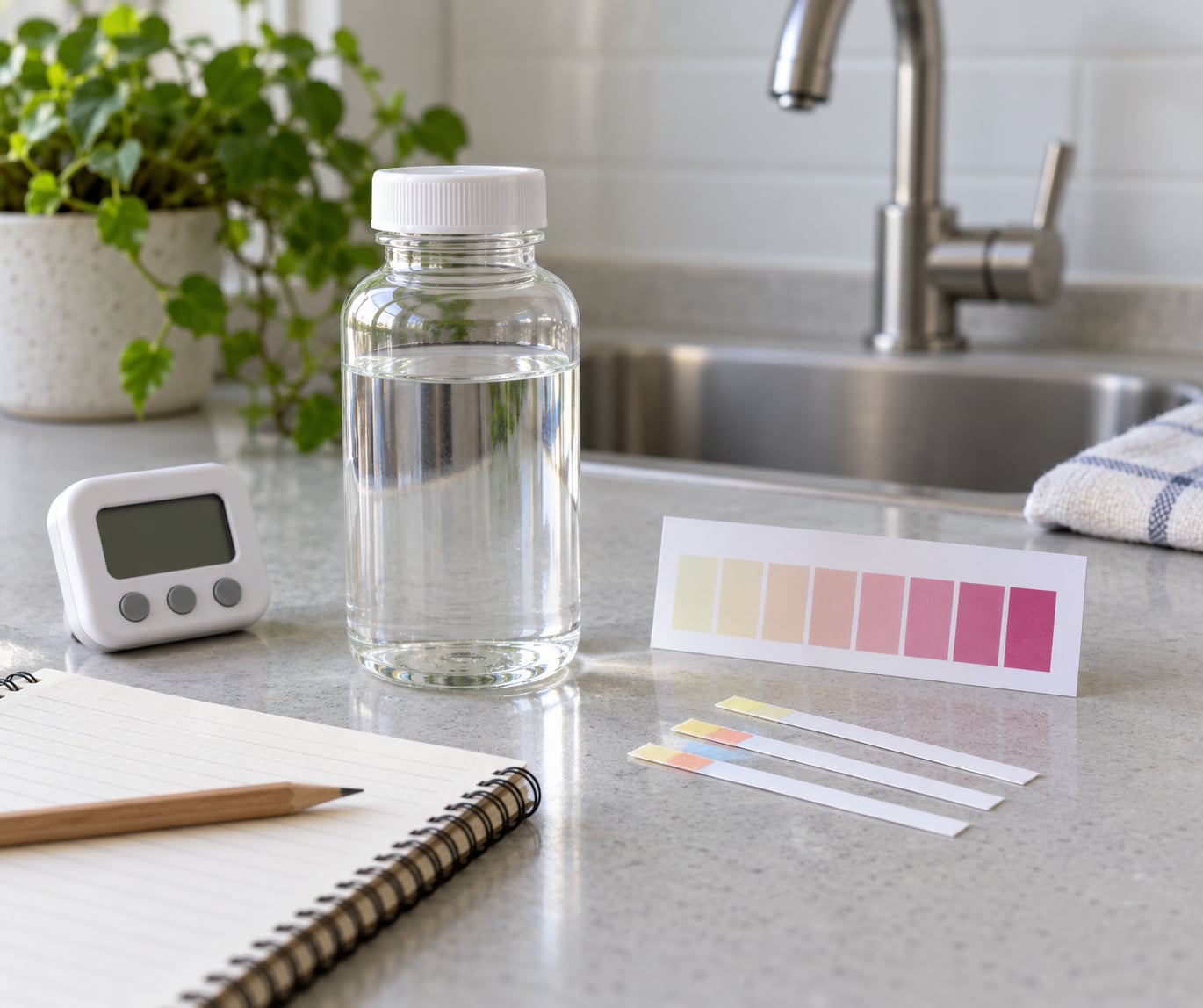
Nitrate testing at home comes down to two families of method: a color-matching strip or liquid kit that gives you a screening number in about a minute, and a mail-in certified laboratory analysis that produces a documented result. The fastest way to test water for nitrates at home is to dip a nitrate test pad into a clean sample, wait out the stated color development time, then hold the pad up to the bottle’s chart in daylight and match the color. If the reading sits anywhere near 10 mg/L, treat it as a prompt to order a lab test rather than a final answer.
The reason 10 mg/L keeps coming up is that it is the EPA maximum contaminant level for nitrate measured as nitrate-nitrogen in drinking water. That single phrase, “as nitrate-nitrogen,” is where most home readings go wrong, and we get to it below. It matters most for private well owners, households with babies under six months or someone pregnant, and anyone living near farmland, a manure pit, a septic system, or a known contamination site.
A home kit is a screening tool. It tells you whether a source deserves a closer look. It does not certify that water is safe to drink, and no strip on the market was designed to do that.
Table of Contents
What You Need
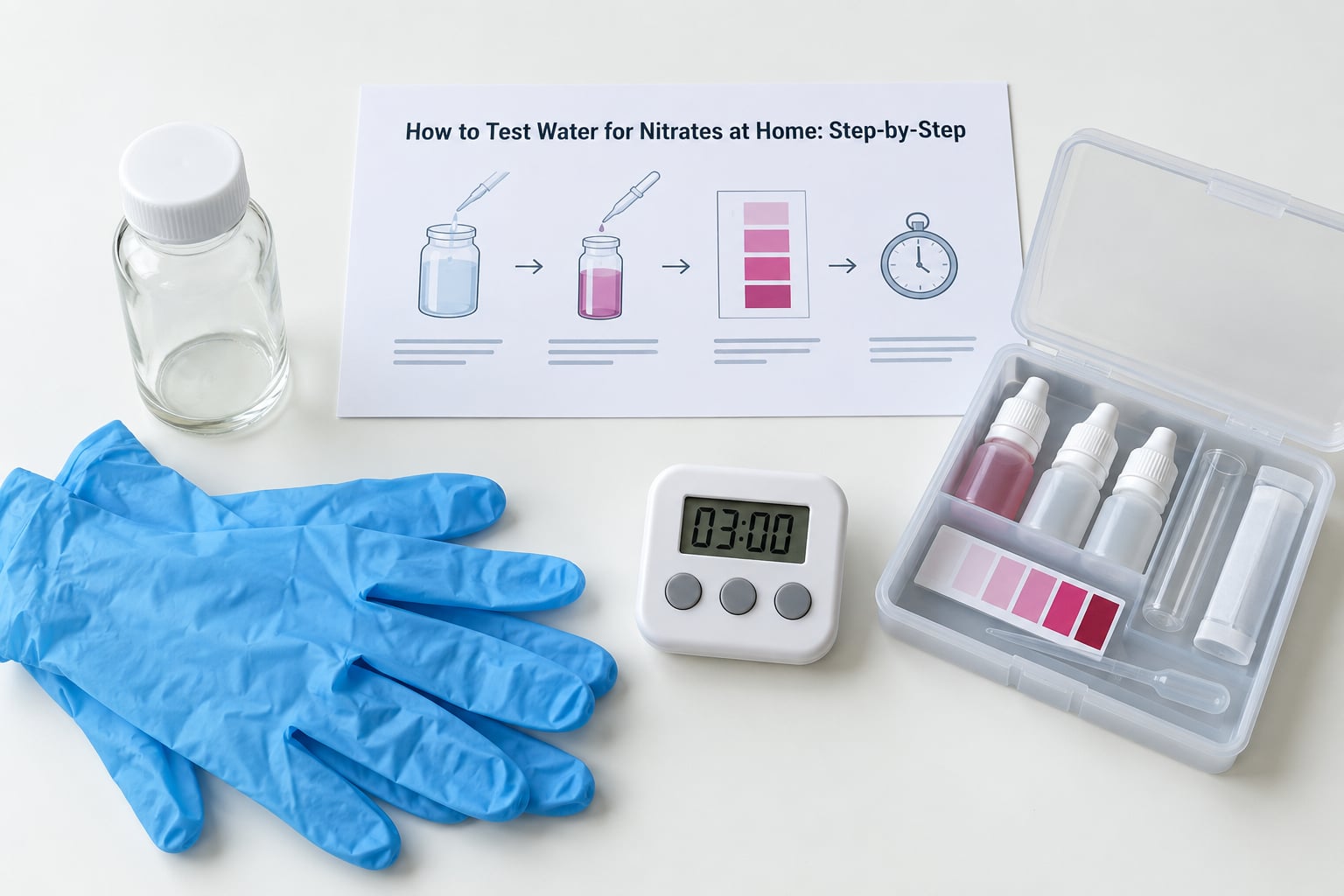
Gather these before you open the strip bottle. Most failed nitrate tests are preparation failures, not chemistry failures.
- A clean sample bottle. Use the bottle the kit came with, or a glass vial with a tight-fitting lid. Rinse it once with the water you are about to test, then discard that rinse.
- Clean gloves or tongs. Your hands carry enough nitrate to matter if you are testing near a lawn that was fertilized last week.
- A nitrate test strip or liquid kit. For drinking water and wells, look for a strip labeled specifically for nitrate, not a general 7-in-1 pool and aquarium strip whose nitrate pad is nearly colorless at drinking-water concentrations.
- The manufacturer’s instructions. Keep them in hand. The development time, pad identity and color chart differ between brands.
- A timer. Phone timers are fine. Development time is not something to eyeball.
- A clean, dry surface and good daylight. A kitchen counter near a window beats a dim basement or a warm-lit room.
- A pen and notebook. Date, source, time of day and result. You will want the history later.
If the water is destined for drinking, one more thing matters: a certified drinking water laboratory. Home strips screen. A state-certified lab documents. Anything that changes what your family does about drinking the water belongs to the lab.
How to Test Water for Nitrates at Home: Step-by-Step
1. Choose a nitrate test that matches your sample
There are three home options, and they trade speed against control.
Colorimetric test strips are the cheapest and fastest. A reagent pad changes color in proportion to nitrate, and you match it to a printed chart. The tradeoff is resolution: the steps near the middle of the scale are wide, and cheap strips often skip from pale to dark right across the range where you most need precision.
Liquid nitrate test kits add reagents in sequence and produce a color you compare against a comparator block or a set of reference standards. More controlled than a strip because the sample volume and reagent order are fixed, and several steps instead of one. They are the tool most aquarium keepers reach for, and forum consensus is that they read accurately but on a nitrate scale rather than a nitrate-nitrogen scale. Divide by 4.43 to compare with the EPA number.
Digital and ion-selective electrode meters remove the color matching entirely. They only help if they are calibrated against a known standard before you start, and if the electrode is fresh. An uncalibrated meter is worse than a strip, because it produces a confident number that means nothing.
| Method | Time to result | Reliability | Best for |
|---|---|---|---|
| Nitrate test strip | About 1 minute | Screening only; coarse near the middle of the scale | First look at a private well, aquariums, garden irrigation water |
| Liquid colorimetric kit | 5 to 15 minutes | Consistent if the steps are followed exactly | Repeat tests, tanks, tracking a source over time |
| Calibrated ISE meter | Instant once calibrated | Good with calibration; poor without | Frequent sampling by someone who will maintain the electrode |
| Mail-in certified lab | Days | Documented result, often EPA Method 300.0 ion chromatography | Any drinking water decision, high or conflicting readings |
2. Prepare the water sample safely
Run the tap for a few minutes before sampling, because water sitting in a pipe overnight can pick up corrosion products and sediment. For a well, sample without disturbing the wellhead and away from where a hose or bucket touches the ground.
Touch nothing. Do not touch the inside of the bottle, the cap threads or the rim. Do not sample in a container you have washed with detergent and not fully rinsed, since detergent residue interferes with the reaction.
Different sources need different handling. Aquarium water should be sampled from mid-tank, not near the substrate, and if you are chasing a spike, take the sample right after feeding. Tap water should be sampled cold and unflushed only if you suspect your own plumbing. Pond and irrigation water may need dilution to sit inside the strip’s range, and dilution has to be recorded, because it changes the math.
Timing matters more than people expect. Spring snowmelt flushes nitrate out of shallow groundwater, late-summer drought and stagnation concentrate it, and heavy rain after a fertilizer or manure application can push a well higher within days. A single spring test can look fine while an August test would not.
3. Perform the strip or liquid test exactly as directed
Using a nitrate test strip:
- Fill the sample bottle to the stated volume. Pour off any excess into the sink, holding the bottle by the label so your fingers stay off the sample.
- Dip only the nitrate pad, usually the last square on the strip, into the sample for about one second. Most brands warn against immersing the whole strip because the comparison pads are already treated.
- Lay the strip flat, pads facing up, on a clean surface. Do not shake it, squeeze it or blot it.
- Start the timer. Many strips ask for 30 to 60 seconds of development, and some need two full minutes.
- Read at the stated time and no later. Color keeps darkening after the window closes.
Using a liquid kit:
- Measure the sample volume into the tube or vial. Eyeballing is the most common error in the whole process.
- Add reagents in the printed order. Some kits need the powder packet added before shaking, others after.
- Cap and invert the specified number of times. Shaking harder than directed can cloud the sample.
- Wait the printed settling time, then compare the color against the comparator block or reference standards while holding both against white paper or in daylight.
Substituting a reagent from a different kit or a different brand almost always ruins the result. The chemistry behind each formula is tuned to a specific color scale, so a stranger’s reagent produces a stranger’s number.
4. How to read a nitrate test strip and record the result
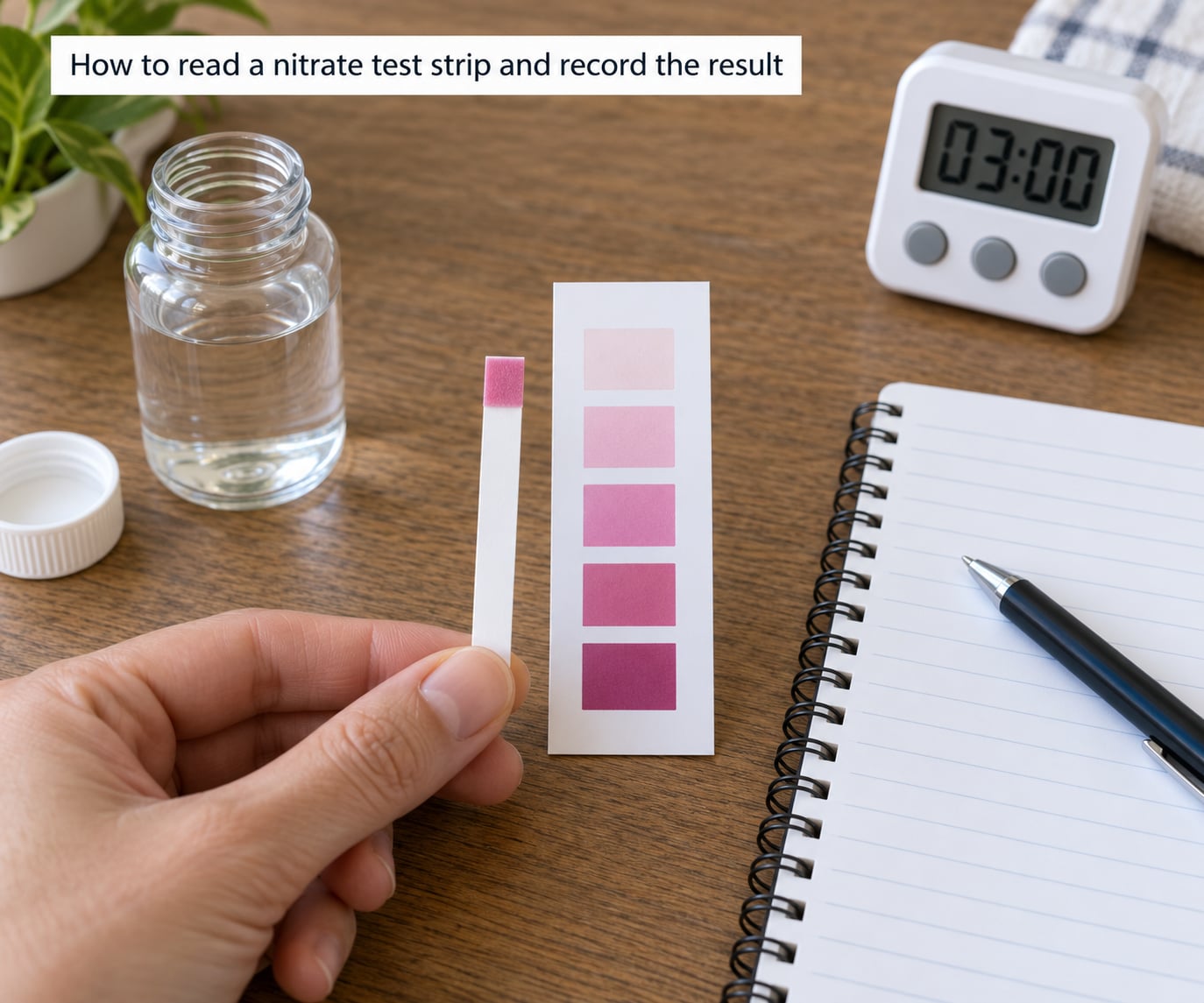
Compare the pad color to the chart at arm’s length, in daylight, and pick the closest swatch rather than the one you hope for. If the pad lands between two swatches, take the higher one, because that is the reading that keeps you cautious.
Write down four things: the number, the unit the chart used, the date and the source. The unit is not a detail. A chart reading 40 is not twice as alarming as one reading 20, because it may be on a different scale entirely.
| What you see on the chart | What it usually means | What to do |
|---|---|---|
| No color change, reads zero | Nitrate below the lowest step on the scale | Recheck the strip expiry and storage; a dead strip reads zero forever. If your source is high risk, confirm with a lab. |
| Faint color, first or second swatch | Below 10 mg/L nitrate-nitrogen on most drinking-water charts | Note it and retest on a schedule. |
| Mid-range color | Around the 10 mg/L action level | Treat as unclear. Send a sample to a certified lab. |
| Dark color at the top of the scale | Above the highest step, possibly well past the chart | Stop treating this water as drinking water, and get lab confirmation the same week. |
Home tests give you a range, not a laboratory value. Nobody reading a strip has measured nitrate to two decimal places, and pretending otherwise is how a 9 mg/L sample gets filed under “fine.”
5. Decide whether the result needs follow-up
A nitrate number only means something once you know which water you sampled and what it is for.
Drinking water. The EPA maximum contaminant level is 10 mg/L as nitrate-nitrogen. The World Health Organization’s guideline is expressed as nitrate itself, which is why the two published numbers differ: 10 mg/L of nitrate-nitrogen equals about 44.3 mg/L of nitrate. To convert a reading given as nitrate into nitrate-nitrogen, divide by 4.43. This unit trap is the single most common source of confusion, and it is why a 40 reading on an aquarium-style scale may correspond to roughly 9 mg/L nitrate-nitrogen, right at the line rather than four times over it.
Aquariums and ponds. Nitrate is a waste product to manage, and the same charts work. There is no nitrate-nitrogen adjustment to make here, so use the scale as printed.
Garden and irrigation water. High nitrate water is not a hazard to the crop, it is a free nitrogen source you may already be paying for twice, so track it alongside your fertilizer plan.
If a reading is elevated and the water is drinking water, do not try to fix it with boiling. Boiling concentrates nitrate as the water evaporates, which is the opposite of what people hope. Carbon and sediment filters do not remove nitrate either. Reverse osmosis and anion exchange do, and a boil-water advisory from a utility generally pairs with bottled or filtered water specifically because treatment is part of the advice.
Free and low-cost routes exist. Citizen-science programs such as Nitrate Watch distribute strips for home sampling, county and city health departments sometimes test private wells at no charge, and university extension offices often lend out kits or run screening clinics. For anything that decides what a family drinks, order from a state-certified drinking water laboratory and ask for nitrate reported as nitrate-nitrogen by EPA Method 300.0.
Common Mistakes
Expired or heat-damaged strips. A strip that has sat in a car glovebox through summer can read zero forever. Store strips cool and dark, sealed, and check the date. This is the most repeated complaint in the forums I read while researching this, and it is the reason a suspiciously clean result deserves suspicion.
Dipping the wrong pad. Multi-parameter strips have a nitrate pad and several other pads. Immersing all of them wets reagents that are not meant to share a sample, and many brands call it out on the bottle.
Reading late. Nitrate pads keep developing color. A pad read two minutes late can look like a step darker than it was, usually in the direction that creates a false alarm.
Reading in bad light. Yellowish kitchen bulbs shift a pale pad toward green and a mid pad toward tan. Overhead fluorescents do the same. Daylight through a window is the cheapest accuracy upgrade available.
Not rinsing the container. Detergent, bleach residue and tap-water minerals all skew a colorimetric read. Rinse with the sample, discard the rinse, then collect.
Ignoring the units. A kit that says ppm nitrate and a chart that says mg/L nitrate-nitrogen are not the same scale. Write the unit next to every number.
Treating zero as proof. Zero on a strip means below the lowest step on the scale, which for many strips is well above zero. If your source is near farmland or a septic system, a zero on a suspect strip is a result to retest, not a clean bill of health.
Treating a strip as certification. Nothing in a strip’s design meets a data-quality standard a regulator would accept. Readings at or above 10 mg/L, or any result that conflicts with the next test, belong to a certified lab.
To make your results repeatable, do the same four things every time: sample at the same time of day, use the same volume, hold the pad flat instead of shaking it, and read under the same light. Repeatability is what turns one number into a trend.
Frequently Asked Questions
Are nitrate test strips accurate?
Nitrate test strips are accurate enough to screen a water source, not to certify it. They are colorimetric, so accuracy depends on the scale’s resolution, your lighting, and your timing. Most drinking-water strips have wide steps near the middle of the scale, which is exactly where 10 mg/L sits. Treat a home result as a prompt to investigate, and confirm anything near or above the action level with a certified laboratory.
Are home nitrate test kits accurate for well water?
For screening, yes. A strip or liquid kit will usually place a well in the right band, and repeating the same method over time gives a trend you can trust. The limitation is resolution near the threshold and the possibility of a dead strip reading zero. If the number changes a decision about drinking the water, or if two tests disagree, send a sample to a state-certified laboratory for a documented result.
What is a safe nitrate level in drinking water?
The EPA sets a maximum contaminant level of 10 mg/L as nitrate-nitrogen for drinking water in the United States. The World Health Organization expresses its guideline as nitrate itself, which is why published numbers differ; 10 mg/L of nitrate-nitrogen is about 44.3 mg/L of nitrate. Concentrations above the limit are associated with reduced blood oxygen carrying capacity, which matters most for infants under six months.
Is 10 ppm nitrate too high for drinking water?
That depends entirely on what the ppm is measured as. 10 mg/L as nitrate-nitrogen sits right at the EPA limit. 10 mg/L measured as nitrate itself equals about 2.3 mg/L nitrate-nitrogen, well under it. This single distinction causes most of the confusion on well water forums, so always check whether the chart or kit reports nitrate or nitrate-nitrogen before you react to a number.
Do aquarium test kits work for drinking water?
Aquarium liquid kits and strips read nitrate accurately, but they report ppm nitrate rather than nitrate-nitrogen, and their scales are usually built for tanks where tens of ppm is the range of interest. To compare a reading with the EPA number, divide it by 4.43. Many aquarium kits also report nitrite, and strips often combine both on one pad, so check that you are reading the right square.
Does boiling or filtering water remove nitrate?
No. Boiling evaporates the water and leaves the nitrate behind, so the concentration in what remains goes up, which is why public boil-water advisories pair the boil with an alternative water source. Standard carbon and sediment filters do not remove nitrate either. Reverse osmosis and anion exchange systems do, which is why they are the treatments named when a utility advises against a well’s water.
Conclusion
Start with a nitrate-specific strip or a liquid kit, collect a clean sample without touching the inside of the bottle, hold the pad flat, and read at the stated development time in daylight. Write the number down with its unit, because a nitrate reading and a nitrate-nitrogen reading are not the same number.
Then decide what the number is for. Aquariums and irrigation water you can act on directly. Drinking water deserves more: anything at or above 10 mg/L nitrate-nitrogen, any dark or off-the-chart color, or any result that contradicts the last one goes to a certified drinking water laboratory. Updated for 2026, and remember that on municipal water your utility is already required to test, while a private well is your responsibility to keep checking.