Oil on seawater never stays the same. The moment it enters the water it is pulled through eight competing processes — spreading, evaporation, dispersion, emulsification, dissolution, oxidation, sedimentation and biodegradation — that together can strip a slick away in days or leave a tarry residue on a beach for decades. Understanding how oil behaves on seawater over time is how anyone building detection gear, running a containment boom, or writing a fate-and-trajectory model decides what they are actually looking at.
One figure captures the scale of the spreading stage: a single ton of oil can cover as much as 12 square kilometres of sea surface within days. That is why a spill that looks catastrophic from a boat window can turn into a thin, patchy film that is far harder to see, sample and recover than the volume suggests.
Below, I walk through what happens at each stage, how the oil’s own properties change as it ages, which environmental conditions push the timeline faster or slower, and how scientists in the field actually work out the weathering state of what they are looking at. Where numbers appear they are the ones reported in the NOAA, National Academies and peer-reviewed literature I drew on; where the evidence is genuinely weak I say so rather than smoothing it over.
Table of Contents
- What Happens When Oil Enters Seawater?
- How Oil Behaves on Seawater Over Time
- What Is the Difference Between Evaporation, Dispersion, and Dissolution?
- Why Does Some Oil Sink While Other Oil Floats?
- What Environmental Conditions Change the Timeline?
- What Does Biodegradation Change?
- Frequently Asked Questions
- Conclusion: Start by Observing the Water Column
What Happens When Oil Enters Seawater?
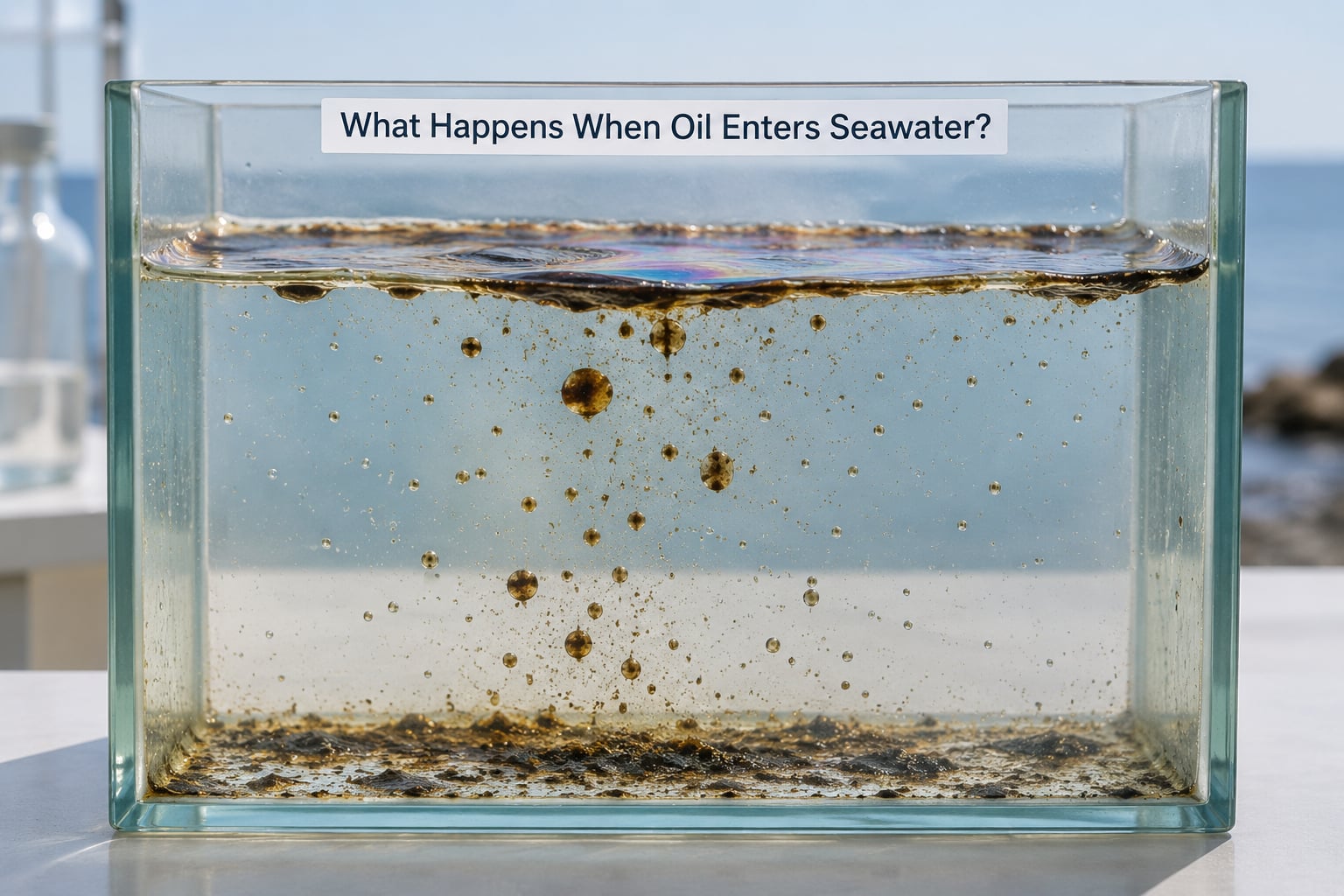
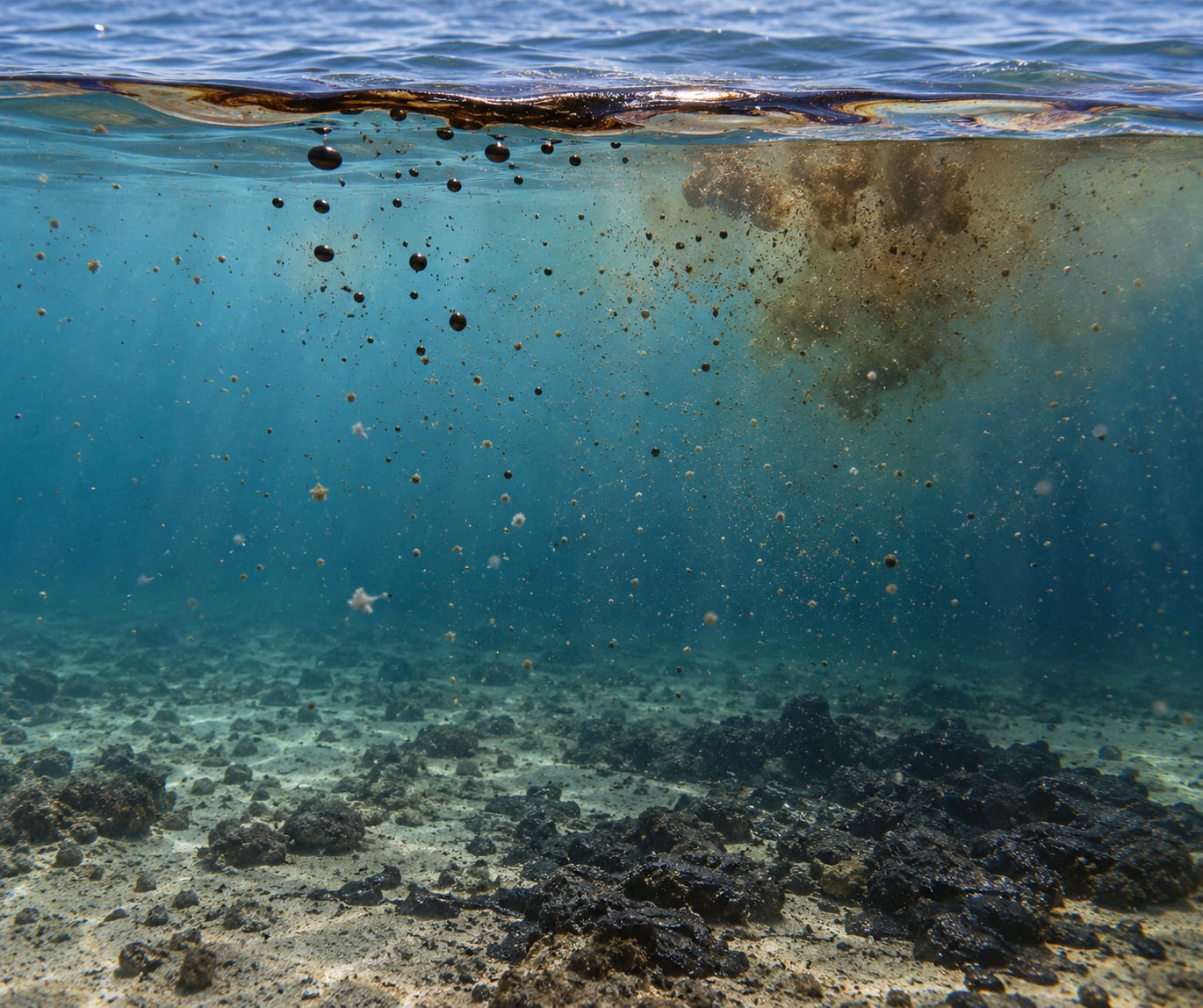
Oil at the surface is not a single thing. It is a slick, then a patchwork of droplets, then dissolved molecules, then residues stuck to particles, and any one sample can contain all four at once. Confusing those states is the most common source of bad conclusions in both response and research.
The sequence starts with release and spreading, when the oil floats because it is less dense than seawater and is pushed outward by surface tension into a thin film. Evaporation follows, stripping out the most volatile hydrocarbons and leaving a heavier, thicker remnant behind. Emulsification runs in parallel, with waves working seawater into the oil until the mixture resembles chocolate mousse.
Dispersion pushes droplets below the surface, dissolution moves individual molecules into the water, and oxidation stiffens the surface film into something tar-like. Sedimentation carries the heavier fractions down, and biodegradation hands the job to microbes, which convert hydrocarbons to carbon dioxide, water and biomass. Nothing here is a clean sequence — several processes run at once and compete for the same oil.
How Oil Behaves on Seawater Over Time
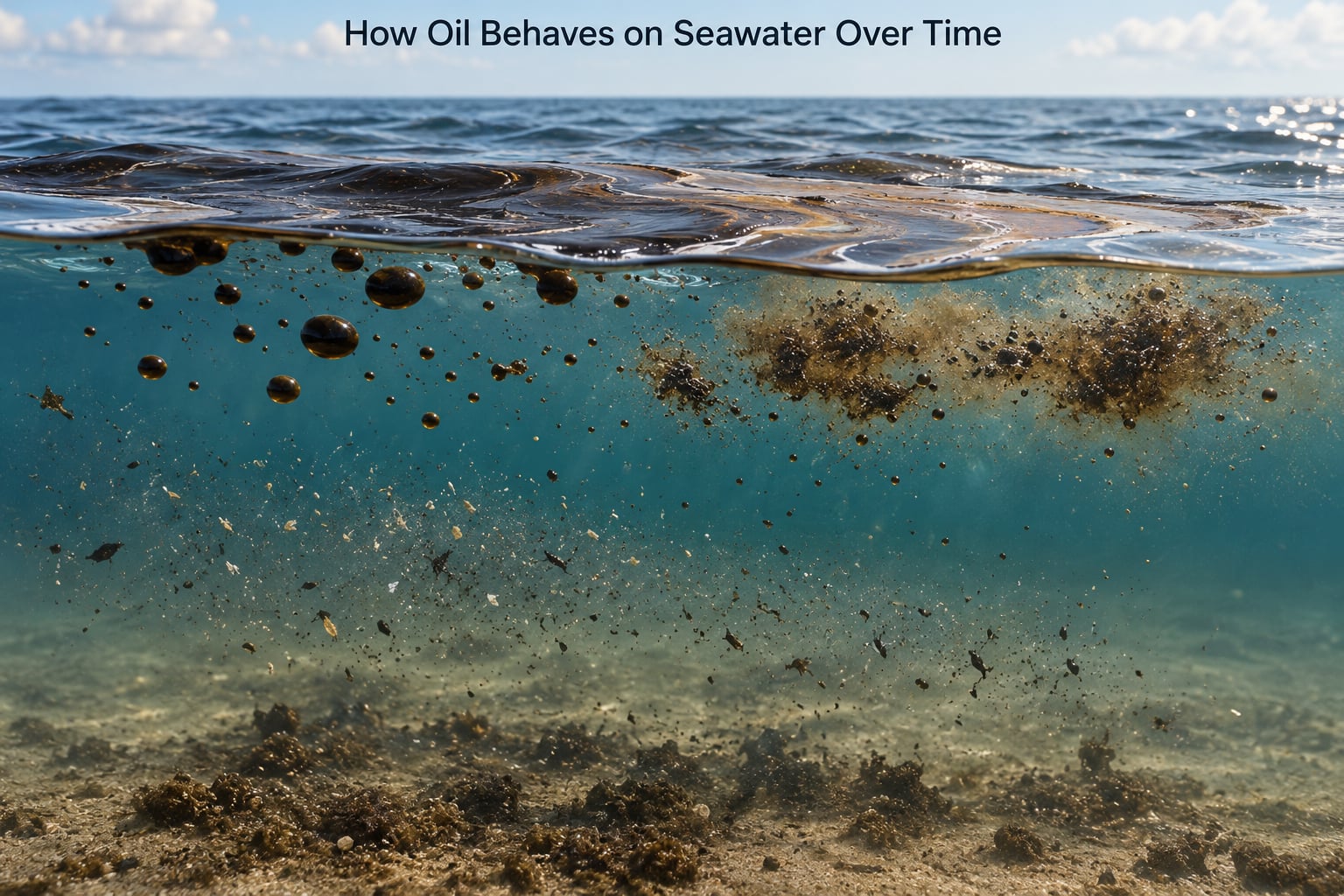
The honest answer to how oil behaves on seawater over time is that no single outcome occurs. Some of it evaporates, some stays floating as a slick, some becomes a water-in-oil emulsion, some disperses into droplets below the surface, and some settles onto sediment or gets eaten by bacteria. The best short description in the technical literature is “days to decades, depending on conditions.”
Why Does Oil Spread Across the Water?
Oil spreads because its surface tension pulls it into the thinnest film gravity allows, and because it is less dense than seawater it rides on top rather than sinking. From there, gravity-driven viscous spreading dominates the first minutes and hours, and the film thins fast as the slick breaks into fingers and patches.
Viscosity is the main brake. A light product such as diesel spreads quickly and thinly; a heavy fuel oil resists and stays in thicker, longer-lived patches. Wind and current then supply the momentum, and sea state supplies the mixing. One ton can cover as much as 12 km² within days, and in a moderate swell the film breaks up and reforms continuously rather than staying a single connected slick.
Temperature works on spreading indirectly, through viscosity. Cold water thickens the oil and slows its movement; warm water thins it. Release volume sets the starting thickness, and a thick slick behaves differently from a thin one in ways that matter later, because a thick slick can skin over and trap its own volatile fraction.
What Is the Difference Between Evaporation, Dispersion, and Dissolution?
They are three different processes that get lumped together constantly. Evaporation moves volatile compounds into the air. Dispersion breaks oil into droplets suspended in the water column. Dissolution moves individual molecules into the water as a true solution. Only the first one leaves the water.
Evaporation is the fastest process at the start. Light petroleum products containing volatile organic compounds commonly lose between 20 and 40 percent of their mass this way, and because the compounds that leave are the lightest ones, what remains is denser and more viscous than what spilled. Once a thick slick develops a surface skin, that skin limits further evaporation, so the mass loss curve flattens.
Dispersion is a wave-driven physical break-up. Breaking waves and turbulence fragment the film into droplets that can be from a few micrometres to millimetres across, and those droplets stay suspended rather than resurfacing. Subsurface droplets from a plume can move in all three dimensions, which is why the National Academies chapter on spill response notes that oil droplets tend to become more dispersed over time, especially below the surface.
Dissolution is minor for most crude oils and more relevant for light products and for the soluble aromatic fraction. It is also the hardest to measure, because the dissolved concentration sits below what most routine water sampling can detect. Open water dilutes it fast, which is why a single acute toxic effect from dissolved crude in the open sea is unlikely even where the total volume is large.
How Does Wave Action Create an Emulsion?
Emulsification happens when breaking waves drive droplets of seawater into the oil rather than breaking the oil into the water. The result is a water-in-oil emulsion with a large volume of water trapped inside a continuous oil phase, and its colour and texture give it the name chocolate mousse.
The volume change is dramatic: mousse can hold so much water that its volume expands as much as fourfold. Viscosity rises by roughly an order of magnitude over the first days for a crude that emulsifies readily, which changes the geometry of the whole problem — there is simply more material to hold in a boom and far more energy needed to separate it.
Emulsification gets worse with wave energy, with the surfactants naturally present in seawater and produced by weathering, and with time as the emulsion stabilises. Temperature matters too: cold water slows surfactant action and stiffens the water droplets. The practical consequence for response is direct. A mousse cannot be skimmed efficiently, and a stabilised mousse resists chemical dispersants because the surfactant has to reach an oil that is now mostly water inside a viscous shell.
Why Does Some Oil Sink While Other Oil Floats?
Oil sinks when its effective density rises above seawater, and it does that in several ways. The main one is compositional: evaporation and gas loss remove the light fractions, so the residue that remains is heavier. Emulsified oil and weathered residues also behave differently from fresh crude, and oil that attaches to suspended sediment particles sinks with them.
Gas loss deserves particular attention. Fresh crude and many reservoir fluids carry dissolved gas, and as that gas escapes the liquid density rises, sometimes enough to start the oil descending before any weathering chemistry has run. Sunlight-driven oxidation then converts some of the surface film into dense, tar-like residue, and the polymerised lumps that wash up on beaches as tar balls are the end point of that pathway rather than a separate phenomenon.
Particle attachment is the quiet one. Oil that sticks to fine sediment or organic detritus becomes a denser aggregate and settles, and it can keep settling as more material sticks to it. Sunken oil does not necessarily disappear, either. Currents can resuspend it, waves can move it along the bottom, and in the deep the sediment surface is disturbed often enough that buried residue can return to the water column.
Sunken oil is also much harder to deal with than floating oil. Skimmers and booms are surface tools, and once oil is below the interface or attached to particles, recovery moves from mechanical collection towards monitoring only.
What Environmental Conditions Change the Timeline?
The controlling variables are sea temperature, wind and wave energy, salinity, dissolved oxygen, nutrient availability, oil composition, the microbial community present, and the amount of suspended sediment. Some push weathering forward, some slow it, and they rarely point in the same direction at once.
| Condition | Effect on weathering |
|---|---|
| Higher sea temperature | Faster evaporation and faster microbial activity; oil thins slightly, which also aids spreading |
| Lower sea temperature | Evaporation slows, oil thickens, degradation slows markedly, emulsions stay more viscous |
| Higher wind and wave energy | More spreading, more dispersion into droplets, more emulsification, faster skinning of thick slicks |
| Calm conditions | Less dispersion and fewer droplets; patches persist and thick slicks hold their volatile fraction |
| Strong sunlight | Accelerates photo-oxidation; surface film stiffens and polymerises toward tar-like residue |
| Dissolved oxygen | Aerobic microbial degradation needs it; depletion in a slick slows breakdown further |
| Nutrients (nitrogen, phosphorus) | Limiting for hydrocarbon degraders; natural attenuation is often nutrient-limited rather than carbon-limited |
| Suspended sediment | Provides particle attachment, which drives oil downward and buries it |
| Light product instead of heavy oil | Much higher initial evaporation, faster disappearance from the surface, less persistent residue |
Two cases from the Deepwater Horizon response show how these variables compound. Local dissolved-oxygen depletion of up to 40 percent was attributed to microbial oxidation of gaseous alkanes in the affected water, which is a reminder that the microbial process can change the conditions that support it. In the same event, dispersant application reduced modal droplet size by roughly threefold, which moved oil from the surface into a subsurface plume where it was tracked chemically rather than visually, with dispersant components such as DOSS and DPnB detected as far out as 300 km and 64 days after application.
How Do Scientists Track Oil Over Time?
No single instrument covers it, so tracking is triangulated. Surface slick state is described by eye against a standard thickness classification, measured with skimmers, checked with fluorescence spectroscopy, imaged by satellite, followed with drifting buoys, and confirmed by collecting water and sediment samples for GC-FID hydrocarbon analysis.
| Visual class | Approximate thickness | What it means for the oil |
|---|---|---|
| Silver sheen | Sub-micron to a few microns | Thinnest film, visible only at oblique angles; often hardest to tell from biological film |
| Rainbow sheen | Microns | Interference colours from a very thin film, produced by the same physics as an oil film on a puddle |
| Metallic sheen | A few microns to tens of microns | Thicker film reflecting the sky; a useful confirmation cue |
| True colour | Tens of microns to about 0.1 mm | Discontinuous patches, brown or dark, where the oil has its own colour |
| Continuous thick oil | Beyond the sheen class, approaching 1 cm and more | Recoverable volume, skimmable, and prone to skinning |
Each method has a limit worth knowing. Satellite and aerial imagery see a surface expression, which is why a slick is often visible from space yet hard to sample — the interesting oil may be in droplets below the surface or in a thin film the sensor cannot resolve. Fluorescence is sensitive but needs the right excitation and suffers interference from naturally occurring surface films, which is the single most common source of coastal confusion about whether a sheen is oil or algal surfactant.
Water sampling with GC-FID gives a number rather than an impression, and it is the method that made the Deepwater Horizon dispersant dataset possible. Sediment traps extend the record below the water column. The honest limitation of all of this is attribution: residue found on a beach is weak evidence of a particular source, which is why officials struggling to explain recurring tar balls on Oregon and Washington beaches in recent years could not settle the origin from the residue alone.
What Does Biodegradation Change?
Biodegradation is microbes metabolising hydrocarbons into carbon dioxide, water and biomass. It is the only process that removes oil carbon from the system entirely, and it is also the slowest of the eight for most petroleum products in cold or oxygen-poor water.
Aerobic degradation, using oxygen as the terminal electron acceptor, is the faster pathway and dominates at the air-water interface and in the mixed layer. Anaerobic degradation works without oxygen and is much slower; it matters in sediment and in the deep, where oxygenated water does not reach. The controlling conditions are the same ones that show up in the table above: temperature, oxygen, and nutrients.
Because crude oil is mostly carbon already, microbial breakdown is often limited by nitrogen and phosphorus rather than by carbon. That is the basis of bioremediation approaches that add nutrients to stimulate degraders, and it is also why natural attenuation in a nutrient-poor offshore setting is slower than the biological potential of the oil alone would suggest.
It is worth separating biodegradation from the other fates, because they all reduce surface visibility. Evaporation removes mass to the air, dilution and dispersion spread it below detection limits, and sedimentation buries it — none of which is degradation. Only the microbial route destroys the molecule. The distinction matters for anyone estimating persistence: an oil that has become invisible because it is dispersed at trace concentration has not gone anywhere, and oil that has been buried in sediment may still be available to anaerobic microbes or to animals for a long time.
For a picture of what persists, the oil budget is instructive: the sources break down roughly as 5 percent natural seeps, about 35 percent shipping, 45 percent atmospheric deposition, effluent and offshore rigs combined, 5 percent undefined, and around 10 percent tanker disasters. Spills are the part everyone pictures and a small share of the total, which is why oil entering the sea from routine operations still sets the baseline condition a sensor has to detect against.
Frequently Asked Questions
How long does spilled oil take to disappear?
Days to decades, depending on conditions. Light products such as diesel lose a large share of their mass to evaporation within the first day or two and thin out quickly. Crude oil leaves a heavier residue that emulsifies, thickens and partly sinks, leaving sediment-bound oil and shoreline tar that can persist for years.
Does oil ever fully degrade in the ocean?
Microbial degradation converts hydrocarbons to carbon dioxide, water and biomass, so oil carbon can be fully mineralised under the right conditions. In practice, complete degradation is the exception. Weathered, emulsified or sediment-bound oil degrades far more slowly, and heavy residues can remain identifiable on a beach decades after the release that produced them.
Why does spilled oil get thicker over time?
Two mechanisms do most of the work. Evaporation strips out the light, volatile hydrocarbons, leaving a denser and more viscous residue, and wave action beats seawater into the oil to form a water-in-oil emulsion that can expand its volume as much as fourfold and raise viscosity by roughly an order of magnitude in the first days.
How can I tell an oil sheen from a natural film?
Oil sheens show interference colours, change appearance with viewing angle, persist in calm conditions, and often collect in wind-aligned streaks. Natural surfactant films from algae are patchier, shift with wind and tide, and coincide with biological productivity. No visual cue is conclusive on its own, so confirmation needs fluorescence or a water sample analysed for hydrocarbons.
Does visible oil show the full extent of contamination?
No. What you see at the surface is only the part that is floating, pooled or visible as a thin film. Much of the oil can be in dispersed droplets below the surface, dissolved at trace levels, or attached to suspended particles and settling to the seabed. Surface imagery consistently understates the volume involved.
What is the biggest source of oil in the ocean?
Natural seeps account for roughly 5 percent of oil entering the sea, and shipping for about 35 percent. The largest single share, near 45 percent, comes from atmospheric deposition, land-based effluent and offshore rig operations combined, with tanker disasters making up only around 10 percent. That gap surprises most people, who picture spills as the main source.
Conclusion: Start by Observing the Water Column
How oil behaves on seawater over time comes down to interacting physical, chemical and biological processes that never stop running, which is why the same release can look like a sheen in the first hour and like scattered tar balls a year later. The first thing to establish is where the oil actually is and what state it is in, since a surface film, suspended droplets, dissolved molecules and particle-bound residue need different answers.
From there, read the conditions before drawing conclusions: sea temperature, wave energy, sunlight, oxygen and nutrients, and the oil’s own composition. Everything else — recovery feasibility, dispersant window, monitoring design — follows from those two steps.