Antifouling options for small boats fall into six main families: conventional copper- and biocide-based antifouling paint (hard matrix and ablative or self-polishing), copper-free hard coatings, biocide-free silicone or foul-release coatings, epoxy and vinyl ester barrier coats, removable films and strippable systems, and simple wax or oil treatments for inflatables, tenders and dinghies. The right one depends on your hull material, the water you sit in, and how much maintenance you actually want to do.
That last point is where most guides go wrong. They hand you a ranked list and skip the part that matters: a coating that fouls in a warm saltwater marina is a different problem from slime on a trailered jon boat in a cold freshwater lake, and the two want opposite chemistry.
Fouling matters more on small boats than people expect. A film of slime and algae adds drag you can feel at low speeds, and heavier growth slows the boat, lengthens stopping distance, and turns a short trip into a longer one. It also hides cracks, blisters and osmosis damage, and traps moisture against the hull underneath. Keeping a clean bottom is one of the highest-value jobs in small-boat ownership.
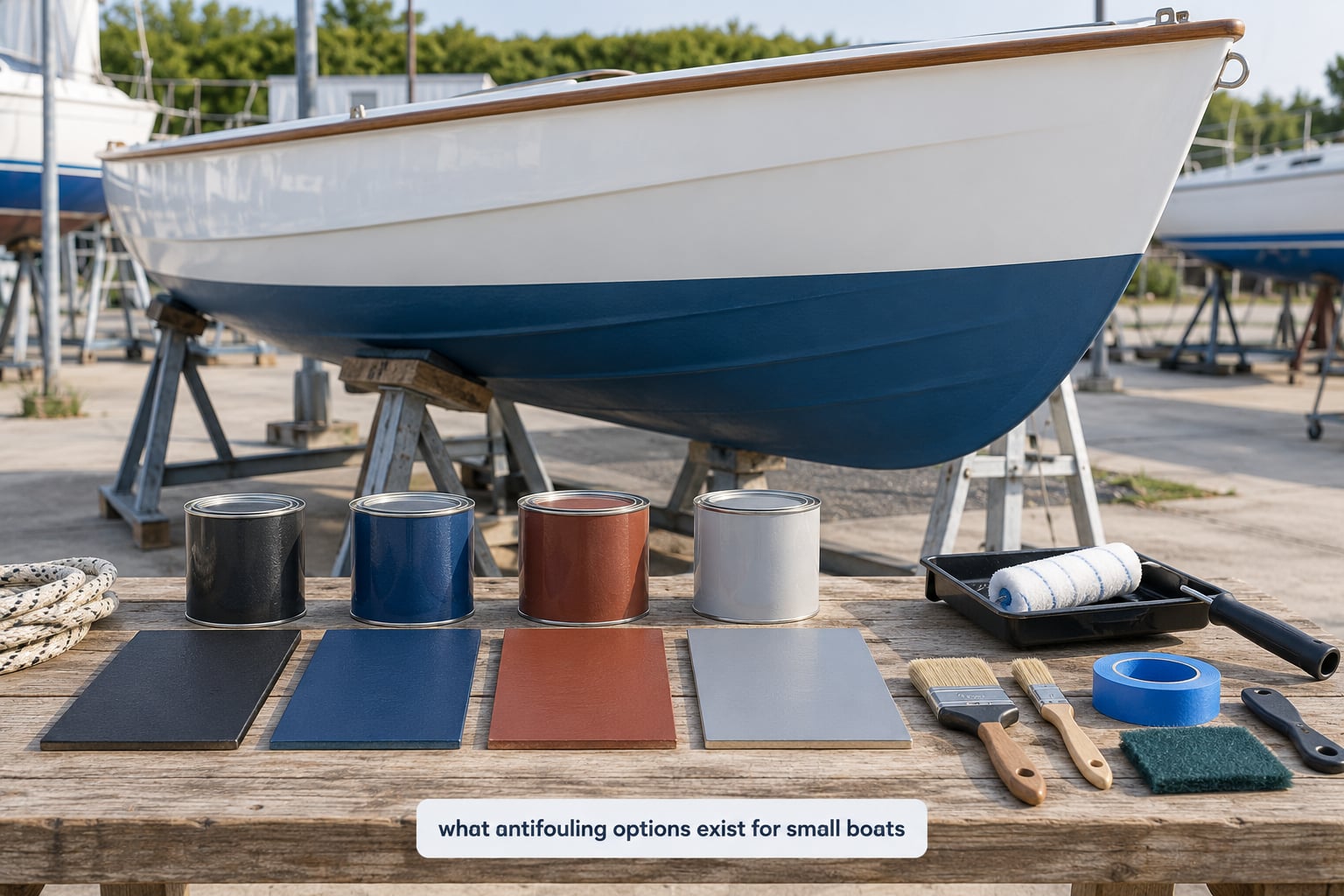
Table of Contents
- What Antifouling Options Exist for Small Boats?
- How Antifouling Protection Works
- Which Antifouling Option Is Best for Each Hull Material?
- Conventional Antifouling Paint Options
- Ceramic, Hydrophobic, and Other Low-Fouling Coatings
- Barrier Coatings, Films, and Temporary Solutions
- Eco-Friendly and Non-Biocide Options
- How to Choose Based on Boat Use, Water, and Budget
- Preparation, Application, and Maintenance
- Common Antifouling Mistakes
- Frequently Asked Questions
- What is the best antifouling option for a small trailerable boat?
- Can you use antifouling paint on an aluminium boat?
- What are the two types of antifouling paint for boats?
- How long does antifouling last on a small boat?
- Do you need to sand before applying antifouling?
- Do eco-friendly antifouling options actually prevent growth?
- Conclusion: Start With the Hull and Use
What Antifouling Options Exist for Small Boats?
If you strip the naming conventions back, antifouling paint divides into two types: hard matrix coatings that hold still and do the work chemically, and ablative coatings that dissolve away slowly on purpose. Everything else on the shelf is a variation, an addition, or a non-paint alternative to one of those two.
- Copper-based hard matrix antifouling. Traditional bottom paint. A resin film loaded with cuprous oxide holds firm on the hull and resists abrasion, which suits fast boats and boats that spend a lot of time on a trailer.
- Ablative and self-polishing coatings. Paint that wears away gradually in water, continuously releasing biocide from the fresh surface underneath, so the coating renews itself while the hull stays smooth.
- Copper-free hard antifouling. A hard film that fights fouling with additives other than copper. This is the default choice for aluminium hulls.
- Biocide-free and silicone foul release. A smooth, low-energy surface with no poison in it. Fouling organisms attach weakly or not at all, and light scrubbing resets the surface.
- Epoxy and vinyl ester barrier coats. Not antifouling in the biocidal sense. These seal the hull against water, and on new boats they are often the only coating applied at the factory.
- Wax, oil and non-paint treatments. Sprays, polishes and films for inflatables, tenders, RIB tubes and wooden dinghies, plus light-duty options for boats that come out of the water immediately.
| Coating type | How it works | Best suited to | Main drawback | Typical service life |
|---|---|---|---|---|
| Copper-based hard matrix | Fixed resin film; cuprous oxide biocide leaches slowly | Fast boats, trailered boats, multi-season use | Must be hauled and sanded to recoat; not for aluminium | Two to five seasons |
| Ablative / self-polishing | Film dissolves gradually, releasing biocide as it goes | Boats that sit in a berth and get used lightly | Can wear out fast in warm or fresh water | One to three seasons |
| Copper-free hard | Hard film using non-copper fouling control | Aluminium, steel, and copper-restricted waters | Often a thinner band of what it covers | Two to four seasons |
| Biocide-free / silicone foul release | Very smooth surface organisms cannot grip | Sensitive waters, boats wanting a polished look | Needs a clean gelcoat hull to bond to and periodic scrubbing | Several seasons, then reapply |
| Epoxy or vinyl ester barrier coat | Seals the hull against moisture, no biocide | New builds, trailers, storage in a slip | Stops corrosion but does little against fouling | Matches the hull coating underneath |
| Wax, oil or film | Leaves a slick, low-friction surface | Inflatables, tenders, dinghies, rarely used boats | Not a real coating system; needs reapplication | A season or less |
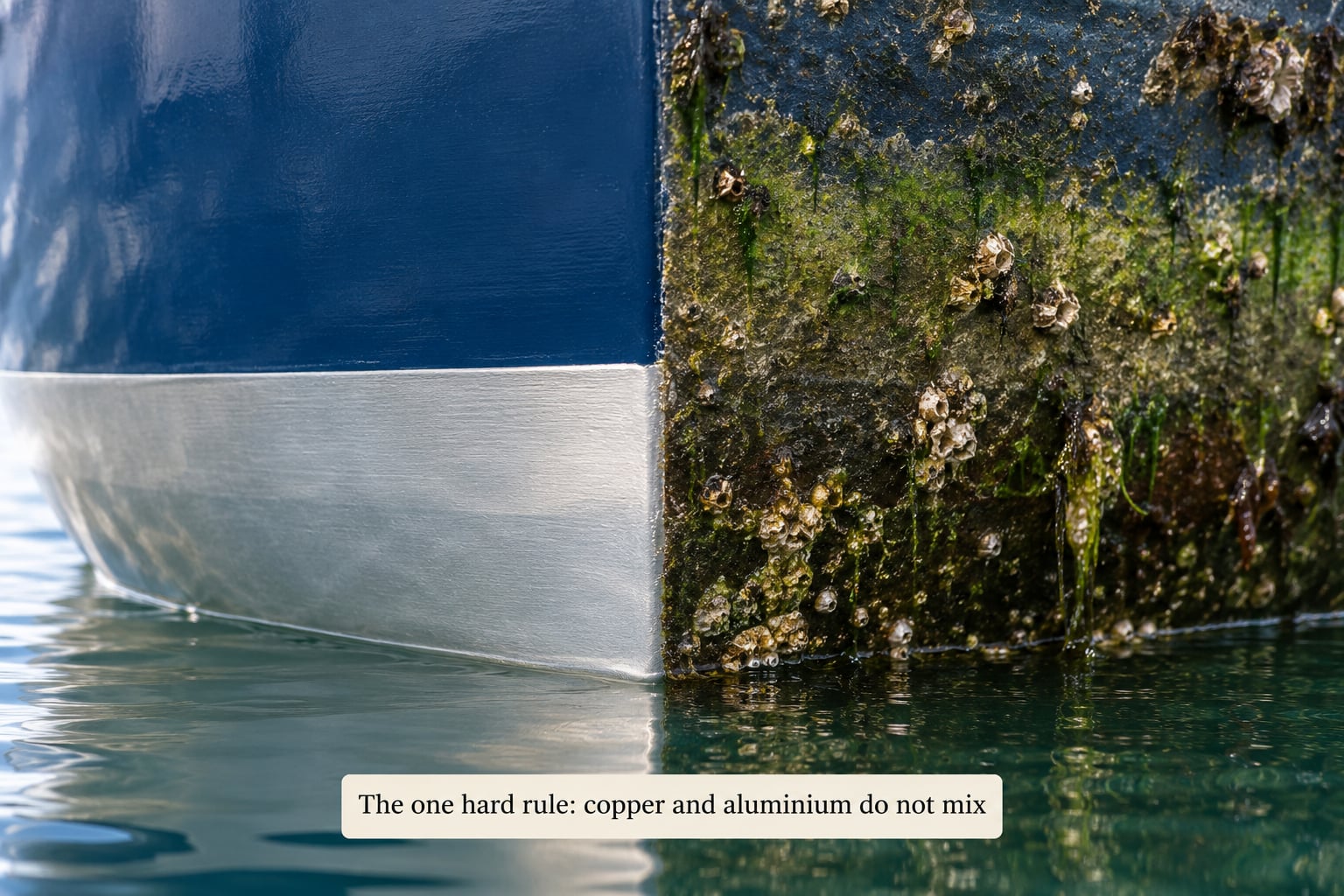
The one hard rule: copper and aluminium do not mix
If you take one thing from this guide, take this. Copper in an antifouling coating and an aluminium hull in the same electrolyte create galvanic corrosion, and the aluminium gives up the electrons. The result is pitting and paint failure that often show up a season or two later, and on a pontoon or an aluminium outboard the damage can spread fast. Copper-free antifouling for aluminium is not a preference, it is the rule.
How Antifouling Protection Works
Biofouling starts almost immediately. In the first weeks a film of microscopic bacteria and diatoms settles on the hull and produces a slippery slime layer. Green and brown algae follow, then larger organisms like barnacles, mussels, tubeworms and bryozoans cement themselves on. The stages matter because each one is easier to remove than the last: slime wipes off, algae needs scrubbing, barnacles need a scraper and a lot of patience.
Antifouling systems work in one of two fundamentally different ways. Biocidal systems release a poison slowly from the coating, killing the organisms that try to settle. Foul-release systems contain no poison at all; instead they present an extremely smooth, low-energy surface that gives growth almost nothing to grip, so anything that does attach comes away with a wipe or a light scrub.
Worth separating clearly, because the labels get mixed up: an anti-corrosion primer stops the hull or metal from corroding, and it is normally underneath the antifouling. A cleaner removes growth that is already there and does nothing to prevent the next layer. A protective film is a physical layer you apply over a hull. And antifouling is the coating doing the actual job of keeping growth off in the first place.
Which Antifouling Option Is Best for Each Hull Material?
Hull material decides more than you would expect. Adhesion, corrosion risk, and what primer is required underneath all change with the substrate, and picking the wrong coating for the material is the most common way people waste a season of work.
Fiberglass
Most small boats, and the easiest case. A sound gelcoat surface takes conventional antifouling well, and hard matrix or ablative coatings both work. Barrier coats, filler and fairing compounds are common repairs on older hulls, and those areas need a compatible barrier coat before antifouling goes on or you will chase blistering all season.
Aluminium
Copper-free only, and that means checking the label rather than assuming. Aluminium also wants an isolating barrier coat because of galvanic coupling with the fasteners, hardware and propeller that are bolted through it. Follow the boat builder’s coating system where you can, because deviating from it voids a lot of warranties.
Wood
Wooden hulls, including many classic and open dinghies, need a coating that lets the timber move and breathe. Two-part epoxy primers are common, and varnishes or oil finishes sit on top. Seal all six sides plus the fasteners, because water trapped under a film in a fastener hole is how wooden hulls rot from the inside out.
Steel
Steel tolerates copper-based coatings and hard matrix paint holds up well on it, but corrosion protection is the real job. Keep the coating system complete, protect the inside of the hull, and watch the waterline area where the boot top meets the hull. More on the coating system itself in the preparation section below.
Composite and specialty hulls
Carbon and advanced composites behave like fiberglass as far as coatings go, but many factory finishes are already epoxy or vinyl ester. Non-skid decks, inflatable pontoons and RIB tubes need their own flexible coatings, and standard bottom paint on a tube will crack and lift.
| Hull material | Copper-based hard | Ablative | Copper-free hard | Foul release | Barrier coat role |
|---|---|---|---|---|---|
| Fiberglass | Yes | Yes | Yes | Yes, needs clean gelcoat | Over repairs and filler |
| Aluminium | No | Only if copper-free | Yes, preferred | Yes, per builder | Isolating coat required |
| Wood | Per builder | Per builder | Yes | Careful, needs flexible system | Epoxy primer essential |
| Steel | Yes | Yes | Yes | Yes | Corrosion protection coat |
| Composite | Yes | Yes | Yes | Yes | Over factory epoxy |
Conventional Antifouling Paint Options
This is the category most people mean when they say bottom paint, and it splits by how the film behaves in water. The two-type answer matters enough to get right, so here it is plainly: hard matrix antifouling stays put and relies on the biocide leaching out of a solid film, while ablative antifouling is designed to dissolve.
Hard vs ablative antifouling: the two types of antifouling paint
Hard matrix coatings are a modified epoxy or vinyl ester film with a high loading of cuprous oxide and usually a second biocide for extra reach. Once cured, the surface is dense and abrasion resistant, so it holds up to speed, to grounding and to being trailered. The catch is that it does nothing on its own surface: if the boat sits still in a fouling-heavy berth, growth settles on it just like any other surface, and it has to come off before you can recoat.
Ablative coatings, also called self-polishing or eroding, put a biocide-loaded resin in a matrix that softens on contact with water and wears away a controlled amount. Wear is the design, not a defect, and in the right conditions a self-polishing copolymer can stay active for a full season without intervention. The downside shows up when the water is wrong for the product: some salt-rated formulas strip out in freshwater far too quickly to do anything useful, which is a well-documented complaint among lake owners.
Between the two sit the soft and medium categories, where manufacturers group coatings by how quickly they erode. Retailers and forums use these words inconsistently, so a better test than the label is the data sheet. Owners on forums consistently weight manufacturer statements about what a product cannot do more heavily than any ranked list, and the water the coating is rated for is the first thing to check.
Hybrid systems mix approaches, and self-polishing copolymer additives get blended into hard resin so a film gets some erosion without losing the whole coat. Nonspolishing ablatives stay put, which helps a boat stored on a trailer because a coating that does not depend on being wet stays effective longer between launches. The rule for trailers is worth remembering: a coating that only works while immersed is losing ground every week the boat sits on stands.
Ceramic, Hydrophobic, and Other Low-Fouling Coatings
Beyond biocidal paint, a second group of options works by making the surface difficult to foul. These include silicone-elastomer foul release, ceramic and ceramic-hybrid coatings, fluoropolymer finishes, and hydrophobic treatments that shed water rather than letting it sit.
Silicone and foul release coatings are the best-known of these. The cured film is extremely smooth and low in surface energy, so algae and slime attach weakly instead of bonding hard. Many of these systems reactivate when you drag a sponge over the hull, which resets the surface without removing paint. The limitation is honest and often left out: the coating needs something solid and smooth underneath, and a chalky, chalked, repaired or previously painted hull is not that surface.
Ceramic and ceramic-hybrid coatings add a harder, glassy or nano-scaled inorganic component to a resin binder, aiming for scratch resistance plus lower adhesion for growth. They appeal to owners who keep their boats indoors or want a gloss finish. Two cautions: preparation is demanding, because these systems bond to a properly prepared surface or not at all, and the field data on long-term fouling resistance is thinner than for the older chemistries.
Hydrophobic and water-shedding treatments are a lighter option, often a wax, polish or spray that leaves the surface slick. They are genuinely useful on an inflatable, a tender or a small trailerable boat that is rinsed and dried after use. They are not a substitute for antifouling on a hull that sits in the water, because the effect is thin and short-lived and needs reapplying.
All of these carry a common trade-off: they do less chemical work and more surface physics, which means they tolerate clean gelcoat far better than a chalked or repaired one, and they reward owners willing to rinse the bottom periodically instead of only looking at it once a year.
Barrier Coatings, Films, and Temporary Solutions
Barrier coatings are the option most guides skip, and they are a real answer in a surprising number of cases. An epoxy or vinyl ester barrier coat is a film that seals the hull surface against water, and it is the coating most new fiberglass boats leave the factory with. For a boat that is mostly trailered, or that gets stored out of the water for months, a properly applied barrier coat with a fairing layer can be enough. It will not stop fouling the way antifouling paint does, but if the boat is not sitting in the water, that hardly matters.
Strippable and sacrificial systems go one step further. Strippable coatings are designed to peel off cleanly at the end of a season so the next application starts from the bare hull, which is convenient and takes a lot of the sanding out of prep. The trade-off is that they leave little or no protective film behind, so the hull is exposed between seasons, and careless removal takes paint with it.
Removable hull films and sacrificial release systems are physical layers. They shed growth by letting it slide off, and the sacrificial ones are designed to disappear over a season or two rather than be stripped. Both are genuinely attractive for owners who would rather not put solvent-based paint near an aluminium hull at all, and both depend entirely on the film being applied and maintained properly. A film that starts peeling at the edges traps water against the hull underneath.
Temporary sprays and wipe-on treatments sit at the light end. On a boat that is rinsed after every outing and never left in the water, a seasonal coat of a suitable protectant is a legitimate low-effort strategy. The important word there is temporary, because none of these last through a season in a fouling-heavy berth.
Eco-Friendly and Non-Biocide Options
Every coating family has an environmental story, and almost all of the marketing around that story is oversimplified. The useful thing to know is what a label actually means before you trust it.
Copper-free vs biocide-free: two different claims
Copper-free means no copper. That matters because copper is the active ingredient in most conventional antifouling, and copper accumulates in sediments around boatyards and marinas with measurable effects on sensitive species. Biocide-free is a broader claim: it means no killing agent of any kind, which is what the silicone foul release family is built around. The two labels are not interchangeable, and plenty of marketing blurs them on purpose.
Water-based formulations reduce the solvent load, which matters for your own breathing and for VOC rules, but water-based does not mean non-toxic or copper-free. Botanical and natural extracts, and coatings that release a physical rather than chemical barrier, all fall into the same careful category: lower toxicity claims come with durability questions, and the honest answer is that the long field history is shorter.
Regulation is the reason the list has changed shape. Tributyl tin, once the dominant biocide in bottom paint, was banned outright for small boats because of its toxicity to marine life, and copper restrictions have followed in a growing list of states, water bodies and countries with sensitive or enclosed waters. Rules change, and they differ by country and by waterway, so check the current guidance from the body that governs where you launch before you buy rather than relying on a general article, including this one.
How to Choose Based on Boat Use, Water, and Budget
There is no single best antifouling for small boats. A conditional answer is the only honest one, and it comes down to six questions in this order.
- What is the hull made of? Aluminium rules out copper outright. Wood and steel bring their own primer requirements. Fiberglass is flexible but check for repairs.
- Fresh or salt water, and what temperature? Warm salt water fouls hard and wears ablative coatings quickly. Cold freshwater mostly grows slime and algae, and a salt-rated formula can disappear before it does any work.
- How fast and how often do you go out? Movement is what keeps a hard coating clean. A boat that runs at speed most outings can get by with far less than one that sits at a berth for weeks between trips.
- Where does the boat live between outings? On a trailer, at a dry stack, or in a covered slip changes the answer more than most people expect, because a coating that depends on being wet performs poorly on stands.
- How much maintenance are you willing to do? Haul-out, sanding and recoating each spring is a real cost in time and effort, and honest maintenance tolerance matters more than any performance figure.
- What does the water where you launch allow? Check local copper and biocide restrictions before you commit, and be more careful in enclosed berths and poorly flushed marinas than in open water.
| Situation | Options that fit well | Watch for |
|---|---|---|
| Cold freshwater lake, seasonal use | Copper-free hard, freshwater-rated ablative, barrier coat if trailered most of the year | Slime and algae pressure; do not use a salt-only formula |
| Warm saltwater berth | Self-polishing copolymer ablative, hard matrix if you get out regularly | Ablatives can wear out early; hard coatings foul in an idle berth |
| Boat stored on a trailer | Hard matrix, epoxy barrier coat, seasonal wax treatment | Nothing immersion-dependent; watch for UV on the topsides |
| Fast planing hull or RIB | Hard matrix coating, abrasion-resistant epoxy system | Ablatives erode too quickly at speed |
| Enclosed marina berth | Copper-free hard, self-polishing, foul release | Poorly flushed water, the highest fouling pressure you will meet |
| Aluminium hull | Copper-free coating plus isolating barrier coat | Galvanic corrosion wherever copper or bare metal is exposed |
| Sensitive or restricted water | Biocide-free foul release, copper-free hard, barrier coat | Confirm current local rules before buying |
On cost, it is easier to think in cost per season than per gallon. A cheap coating that lasts one season in warm salt water can cost more per year than a more expensive coating that lasts three, and a hard coating that survives two seasons changes the math again. Add the haul-out, the abrasion media and the labour, because for most small boats those exceed the paint itself. Prices move around, so read current figures off the shelf rather than trusting a number from any article, including this one.
Preparation, Application, and Maintenance
Most coating failures I hear about trace back to prep rather than to the paint. Follow the coating manufacturer’s instructions and the boat builder’s recommendations, because they are the only ones with a warranty behind them.
How to tell what coating is already on your hull
This is the step that saves the most rework. If the existing coating is hard, sand it to a feathered edge and recoat. If it is ablative, a sound remaining film can often take a new coat after cleaning and light abrasion. Never apply a vinyl ester or epoxy coating directly over another vinyl ester or epoxy film; that pairing will not adhere. A coarse nail or coin test helps: a hard film stays intact, an eroding film rubs to powder. When in doubt, the previous owner, the boat dealer or the yard that built it is the fastest source of truth.
The application sequence
- Haul out and inspect. Look for blisters, soft spots, delamination and corrosion before you commit to a full job.
- Clean the surface. Remove waxes and oils with the specified cleaner, and pressure wash to get rid of loose growth. Paint does not bond to a surface that is merely dry-looking and still holds a wax film.
- Repair and fair. Fill blisters, faired areas and any previous repair compound, then sand the repair to a smooth, even surface.
- Sand or abrade. Sand hard coatings to a feathered edge; lightly abrade a sound previous coat when the product allows. Feather edges matter more than grit.
- Barrier coat and primer. Apply the isolating or corrosion barrier coat your system specifies, particularly on aluminium and steel.
- Coat. Apply in the right temperature and humidity range, with good ventilation, and respect the film thickness the data sheet calls for. Too thin is the usual failure.
- Cure and launch. Follow the stated cure time, and note that launching early is the single most common reason a fresh coating peels within a season. Apply well before you need the boat in the water.
Follow the data sheet for drying and cure times rather than the dry-to-touch feel, because humidity and temperature shift both. Wear the specified respiratory and eye protection, and never spray a hull indoors or in a garage with the door shut. Many small-boat owners apply by roller or brush for exactly this reason, and a good roller coat is a perfectly respectable job.
Once in the water, a light rinse between outings and an occasional scrub on the slime layer will do more for a coating’s life than any product upgrade. If you have a foul release system, that periodic wipe is not optional.
Common Antifouling Mistakes
- Coating over moisture. Osmotic blistering starts with water trapped between coats. Dry the hull properly and check the weather window before you start.
- Using an incompatible primer or topcoat. Especially epoxy over epoxy. This is the leading cause of a coating that peels off in sheets after a season.
- Skipping prep because the hull looks clean. Wax, polish and fuel residue are invisible and completely wreck adhesion.
- Launching before the stated cure time. Immersion before cure softens the film and it flakes away under way.
- Ignoring the propeller, outdrive, shaft and boot top. Fouling on the running gear costs you speed and unbalanced the boat. Many owners treat the boot top stripe and hull as one surface when the manufacturer treats them as two.
- Using a coating rated for the wrong water. A salt-rated ablative in a freshwater lake can be gone before the season ends.
- Putting copper-based paint on aluminium. The galvanic corrosion rule again. It is the most expensive mistake on this list.
- Storing a coated boat in the water, unused. Fouling settles fastest on a stationary hull, and no coating is designed for permanent idleness.
- Expecting a cosmetic coating to stop corrosion. A slick top surface says nothing about what is happening under the film on a steel or aluminium hull.
Frequently Asked Questions
What is the best antifouling option for a small trailerable boat?
For most trailerable small boats, a copper-free hard matrix antifouling or a full epoxy barrier coat suits the usage pattern best, because these coatings do not depend on staying immersed to keep working. A trailered boat loses effectiveness from any immersion-dependent coating every week it sits on stands. If the boat is aluminium, copper-free is not optional. For a fiberglass hull used heavily, add a freshwater-rated or saltwater-rated hard coating and plan on two to four seasons before recoating.
Can you use antifouling paint on an aluminium boat?
Yes, but only a copper-free product. Copper in the coating and aluminium in the hull form a galvanic couple when submerged, and the aluminium corrodes and pits as a result, usually showing up within a season or two. An isolating barrier coat between the metal and the coating is standard practice on aluminium. Steel fasteners, hardware and a propeller in the water make the coupling worse, not better, so the complete builder-specified system matters more here than on any other hull material.
What are the two types of antifouling paint for boats?
The two types are hard matrix and ablative. Hard matrix antifouling cures into a dense, abrasion-resistant film and relies on biocide leaching from that fixed film, which makes it durable but in need of haul-out and sanding to recoat. Ablative antifouling is designed to dissolve gradually in water, releasing biocide from the surface as it erodes, so it stays active and smooth. Everything else sold as bottom paint is a variation on one of those two behaviours.
How long does antifouling last on a small boat?
It depends on the coating family and the water. Copper-based hard matrix typically lasts two to five seasons, copper-free hard coatings two to four, and ablative or self-polishing coatings one to three. Warm salt water and enclosed berths shorten service life, while cold freshwater mostly produces slime rather than heavy hard growth. Storage out of the water can either extend coating life or dull the topsides through UV, depending on the product. A trailered boat in a covered slip at the low end of those ranges may need almost no antifouling at all.
Do you need to sand before applying antifouling?
Sometimes, and the rule depends on what is already on the hull. Sand a hard matrix coating to a feathered edge so the new film has something to key into, and expect to do this every season. A sound remaining ablative layer often only needs cleaning and light abrasion before recoating, which is the main practical advantage of self-polishing systems. The compatibility rule matters more than the sanding: never apply a vinyl ester or epoxy coating directly over another epoxy or vinyl ester film, because it will not adhere.
Do eco-friendly antifouling options actually prevent growth?
They prevent growth in a different way, and the difference is worth understanding. Biocide-free silicone and foul release coatings contain no killing agent; they present a very smooth, low-energy surface that growth cannot grip, and light scrubbing reactivates it. Copper-free coatings still work chemically, just with a different active system. Both are legitimate, and both need a well-prepared hull to bond to, because adhesion problems show up as peeling rather than as fouling. Copper-free does not mean biocide-free, and check the current rules for the waterway you launch in before buying.
Conclusion: Start With the Hull and Use
Start with the hull material, because it eliminates whole categories instantly, and copper-based antifouling is off the table for anything aluminium. Then check what the boat builder specified as the coating system, and identify what coating is already on the hull before you choose a topcoat.
From there, match the option to real use: how fast you go, how often, how long the boat sits between outings, and what the water where you launch allows. Pick a complete compatible system rather than a single product, follow the manufacturer prep and cure times, and plan a maintenance schedule you will actually keep. That sequence shortens the choice more reliably than any ranked list ever will.