Sharing environmental data openly means publishing your measurements with enough documentation that a stranger can understand them, a license that says what others may do with them, and a home in a repository that will still hold them in five years. It takes a few focused hours for a small dataset, and the work scales with how much metadata you carry out of the field with you. The workflow below walks through all seven stages, from deciding who the data is for to keeping it alive after your grant ends.
One thing to clear up early: open does not mean everything, everywhere, instantly. Plenty of environmental data has legitimate reasons to stay restricted, like the location of a nesting site or the address of a household behind a leaking valve. Open describes how well the data is documented and licensed, not whether every field is public. Get that framing right and the rest of the process is mostly bookkeeping, done carefully.
This guide is written for marine researchers, open-hardware builders, community monitoring groups and citizen scientists. It assumes you have measurements and a sense of who cares about them, but not that anyone has told you what a data dictionary is or where to deposit a file.
Table of Contents
- What You Need
- Step-by-Step: How to Share Environmental Data Openly
- 1. Define the dataset and its intended users
- 2. Clean and organize the files
- 3. Add metadata and quality information
- 4. Choose an appropriate repository
- 5. Select a clear reuse license
- 6. Deposit the package and publish a landing page for sharing environmental data openly
- 7. Preserve, cite, and update the dataset
- Common Mistakes
- Frequently Asked Questions
- What is the difference between open and accessible environmental data?
- Where should I publish environmental data?
- Which license should I use for environmental data?
- How do I protect community privacy when sharing environmental data?
- How do I write metadata for sensor data?
- How do I keep a dataset available after grant funding ends?
- Conclusion
What You Need
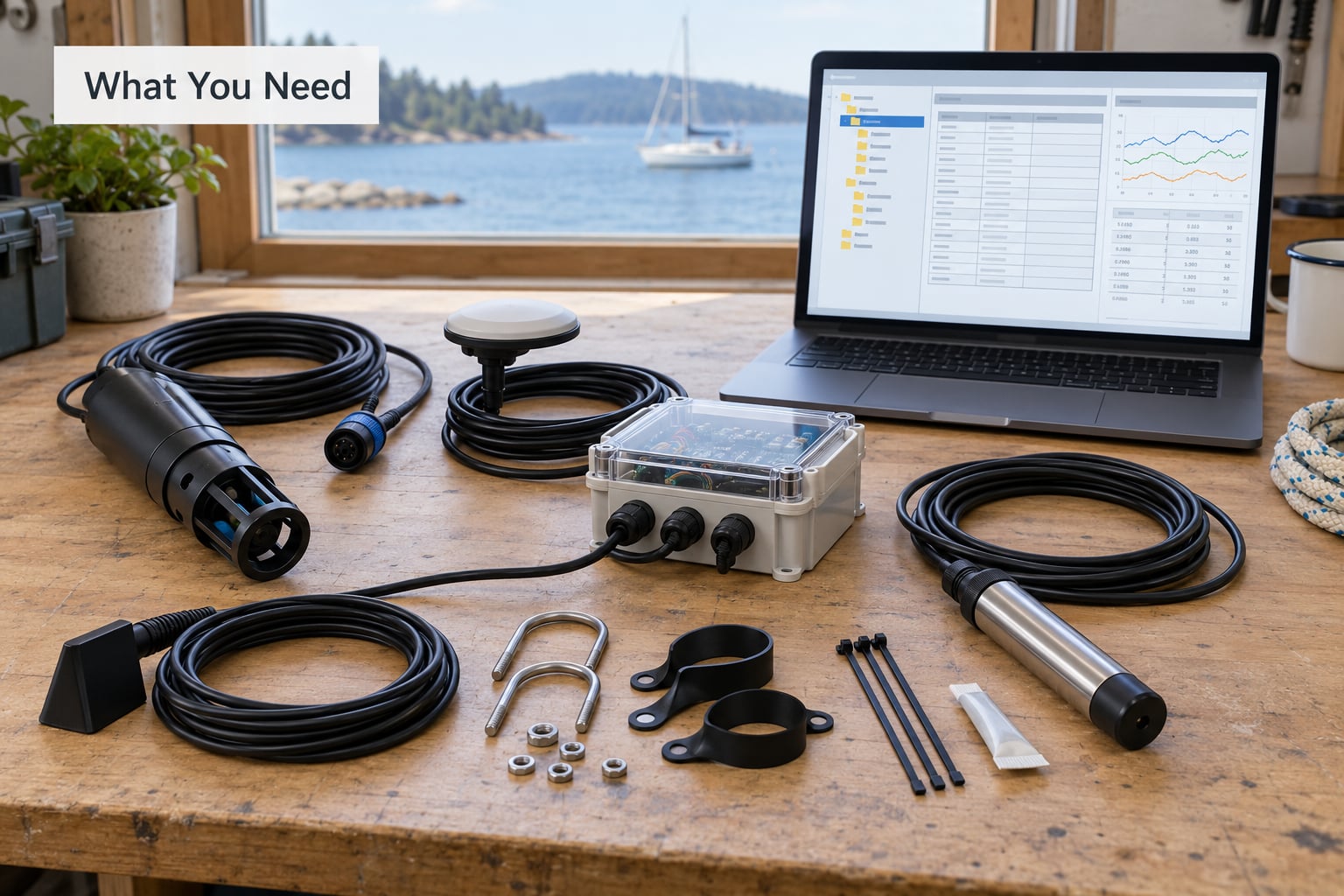
You can start before the instrument leaves the bench, but three things need to exist before you upload anything. The rest can be created during the process.
- Organized source files. One directory per deployment or sampling campaign, with filenames that say what the file is rather than what your computer called it.
- A data dictionary. A table where every column has a plain-language name, unit, data type and permitted values. This is the single most useful file you will write, and the one people most often skip.
- Unit and coordinate details. Which system your coordinates are in, which vertical datum, how depth or elevation was measured.
- Timestamps and time zone. Whether stamps are local, UTC or device time, and what happens when the logger clock drifts or resets.
- Quality and calibration information. Calibration dates, before-and-after readings, detection limits and any flags you applied to suspicious values.
- A suitable repository. Chosen before the upload, because it dictates file formats, metadata fields and identifier type.
- A reuse license. Chosen with your collaborators, not after the first download request arrives.
- A responsible contact. A named person or role with an email address that will still be read.
If you can only gather three of those today, gather the data dictionary, the calibration history and the contact. Those three decide whether anyone trusts the rest.
Step-by-Step: How to Share Environmental Data Openly
Seven stages, in order. Each one has a check you can run before moving on, and each check is cheap compared with fixing the problem after publication.
1. Define the dataset and its intended users
Write down the environmental question the data answers, the geographic and temporal coverage, the variables measured, and who you expect to reuse it. That list might be a coastal monitoring group, a university lab, a municipal water department and a journalist, and each of those audiences reads a different subset of the same files.
At the same time, mark what should stay restricted. Sensitive species locations, private property boundaries, home addresses visible in neighborhood air-quality grids and infrastructure details that could help someone do harm all belong on that list.
Check: ask a colleague outside your project to read your scope paragraph and say back what the dataset does and does not contain. If they guess wrong, rewrite the paragraph.
2. Clean and organize the files
Produce analysis-ready files from the raw ones without deleting the raw ones. Keep both, in separate folders, with a note explaining the relationship. Use consistent, dated filenames like site03_water_temp_2026-05.csv rather than final_v2_reallyfinal.csv.
Preserve units rather than converting them silently, record every transformation in a processing log, and keep the code that did the work in the same repository. Drift corrections, unit conversions and outlier removal all belong in that log with a date and a reason.
Check: open one processed file and trace each changed value back to a specific documented step. If a value changed for reasons nobody wrote down, delete the processed copy and start that part again.
3. Add metadata and quality information
Write two things: a machine-readable metadata record and a human-readable data dictionary. The dictionary covers variable names, units, sensors used, calibration history, sampling interval, coordinates, time zone, missing-value codes, estimated uncertainty and conditions during collection.
Sensor documentation deserves more care than it usually gets. Researchers building open hardware networks repeatedly ask how to record drift and calibration so that a year-old dataset is still defensible, and the honest answer is unglamorous: log every calibration date, note which readings were taken while a sensor was out of range, and flag them rather than deleting them.
FAIR is the usual shorthand here. Findable means a persistent identifier and searchable metadata; Accessible means retrievable through a standard, open protocol; Interoperable means controlled vocabularies and community formats rather than home-grown ones; Reusable means a clear license and provenance. It is a checklist for the package you are assembling, not a legal status.
Check: hand a single value and its dictionary entry to someone outside your field. If they cannot state the unit, the uncertainty and the conditions, the dictionary is not finished.
4. Choose an appropriate repository
Three families exist: general repositories that take anything, domain repositories that enforce community metadata standards, and institutional or project archives. Compare them on preservation commitments, identifier support, metadata features, access controls, file-size limits and who is accountable in year ten. None of the options below charges a fee to deposit data.
| Repository | Best for | Identifier | Watch for |
|---|---|---|---|
| Zenodo | Any discipline, mixed data and code | DOI | No discipline metadata standard, so you must document variables yourself |
| GBIF | Species occurrences and biodiversity records | DOI | Requires Darwin Core fields; non-biodiversity variables fit awkwardly |
| EDI Data Repository | Freshwater and stream ecology data packages | DOI per package | Data package structure is stricter than a single file |
| Pangaea | Earth, ocean and polar science datasets | DOI | Project templates expect standard oceanographic parameter names |
| ESS-DIVE | Environmental genomics and microbiome data | DOI | Sequence data needs a life-science accession number alongside it |
| Dryad | Datasets attached to publications | DOI | Best when the data supports a specific paper |
None of these stores anything permanently on their own; they commit to preservation policies and third-party backup arrangements, which is a very different promise from a lab server or a personal website.
Check: confirm the repository accepts your formats and issues a persistent identifier. If it does not, it is the wrong repository for this dataset.
5. Select a clear reuse license
Open licensing for environmental data is mostly Creative Commons, with custom data use agreements for cases that need conditions a standard license cannot express. Pick the least restrictive option your situation allows; open licenses reuse better because reuse lawyers are a scarce resource.
| License | What people reusing the data must do | Fits when |
|---|---|---|
| CC0 | Nothing, attribution appreciated but not required | Public domain or government data, or data where you have rights to waive them |
| CC BY 4.0 | Credit the source and link the license | The default choice for most research and monitoring datasets |
| CC BY-SA 4.0 | Credit, and share adaptations under the same terms | You want derivatives to stay open, such as derived indicator layers |
| Custom data use agreement | Whatever terms you write, including embargo or ethical-use clauses | Community-governed data, sensitive species locations, Indigenous data under CARE principles |
A license never overrides informed consent, confidentiality obligations or the law in your country. If a community collected the data, they usually hold a stake in how it is used even when a university hosts the deposit. Agree the terms with them before you publish, and record the exact license name and any attribution wording with the dataset itself.
Check: open the repository record in a private window and confirm the license statement is visible on the landing page, in plain language.
6. Deposit the package and publish a landing page for sharing environmental data openly
Upload the data files, the metadata record, the data dictionary, the processing log, the code needed to reproduce your processing, and a plain-text citation file. A dataset that cannot be regenerated from its own package will lose users the first time someone tries to reproduce it.
The landing page needs a plain-language summary that a local official or journalist could read without jargon, a named contact, version information, links to related publications and a stable citation. Say what the data cannot tell you, including sensor blind spots and periods of downtime.
Check: download every file from the landing page in a logged-out session, follow the citation instructions literally, and confirm both work. This catches broken links and permission problems before anyone else finds them.
7. Preserve, cite, and update the dataset
Write a maintenance plan: where backups live, who checks that the repository link still resolves, how corrections get issued, and what happens if your institution closes or your grant ends. Projects that die at the end of funding usually die because nobody named a maintainer.
Use a new version for substantive changes and keep the original record findable, because published papers will cite it forever. Link the dataset from your papers, dashboards and funder reports, and ask users to cite the DOI rather than your website.
Check: six months later, have a colleague locate the dataset from the DOI alone, download it and interpret a value. If they need you to explain anything, one of the earlier stages was skipped.
Common Mistakes
Most published environmental datasets are not wrong. They are unusable in small, specific ways, and the causes repeat.
- Publishing spreadsheets with no definitions. A column called
tempcould be Celsius or Fahrenheit. Fix: ship the data dictionary in the same deposit, not as a separate link. - Ambiguous file names.
data_final2.csvtells a stranger nothing. Fix: a naming convention with site, variable and date, applied to every file. - Mixed units. Depth in metres on one deployment and feet on the next. Fix: one unit per variable, documented, with conversions recorded in the processing log.
- Omitting sensor limitations. Detection limits and dropouts never appear, so downstream users treat noise as signal. Fix: a limitations paragraph in the metadata and quality flags in the data.
- Choosing a license by accident. The repository default is applied without discussion. Fix: decide with your community or collaborators first, then match the license to that decision.
- Uploading only processed data. The raw readings, which support independent verification, stay on a laptop. Fix: deposit both, or explain in writing why the raw data cannot be released.
- Letting the link rot. A lab page disappears and the dataset becomes unreachable while a paper still cites it. Fix: rely on a repository with a preservation commitment, not a personal page.
Before you publish, run a five-minute review with one person who did not collect the data. Ask them to find one value, state its unit and uncertainty, and tell you what the dataset cannot answer. Whatever they stumble on is the last thing standing between you and a usable deposit.
Frequently Asked Questions
What is the difference between open and accessible environmental data?
Open data carries a license that permits anyone to reuse it without asking. Accessible data may be viewable or downloadable only after registration, negotiation or approval, which suits sensitive records but discourages independent reuse. For air quality, water quality and climate measurements, open plus clear documentation is the usual target; for sensitive species locations and household-level readings, controlled access often serves the community better.
Where should I publish environmental data?
Use a domain repository when your data fits a community standard, such as GBIF for biodiversity occurrences, EDI for freshwater ecology, Pangaea for ocean and polar science, or ESS-DIVE for environmental genomics. Use a general repository such as Zenodo or Dryad for everything else. Domain repositories give better discoverability because search tools index their metadata; general ones are more forgiving about format.
Which license should I use for environmental data?
CC BY 4.0 is the safest general choice because it requires credit without restricting reuse. CC0 removes even the credit requirement and works well for public domain or government material. CC BY-SA suits datasets you want to keep open in derived forms. When a community collected the data or the records include sensitive locations, write a data use agreement with the community rather than choosing a standard license alone.
How do I protect community privacy when sharing environmental data?
Aggregate or offset coordinates before publication, remove household addresses and any field that identifies a property or person, and get explicit consent from the community that collected the data. Agreement terms should state what the data may not be used for, such as enforcement action against individual households or valuations of exposed properties. Where risk remains high, publish the open summary and hold the fine-grained record under controlled access.
How do I write metadata for sensor data?
Record the variable name, unit, sensor make and model, sampling interval, calibration dates and readings, detection limits, time zone and clock behaviour, coordinate reference system, missing-value codes, uncertainty estimates and conditions during collection. Document drift and outages as flagged values rather than removing them. The test is simple: another researcher should be able to interpret a single value without emailing you.
How do I keep a dataset available after grant funding ends?
Deposit it in a repository with a published preservation commitment and a persistent identifier, rather than on a project website or lab server. Name a maintainer who will answer emails and check that links resolve, keep an independent backup, and publish a new version rather than silently replacing files. Include funding and version information in the landing page so successors know who to contact.
Conclusion
Start with one small dataset. Write its data dictionary while the details are still in your head, keep the raw files, choose a repository that matches the data type, agree the license with the people who helped collect it, and publish a complete package with a contact name and a citation. Then run the five-minute outsider review and fix what they stumble on. Repeat it for the next dataset and the practice stops feeling like a project and starts feeling like housekeeping.